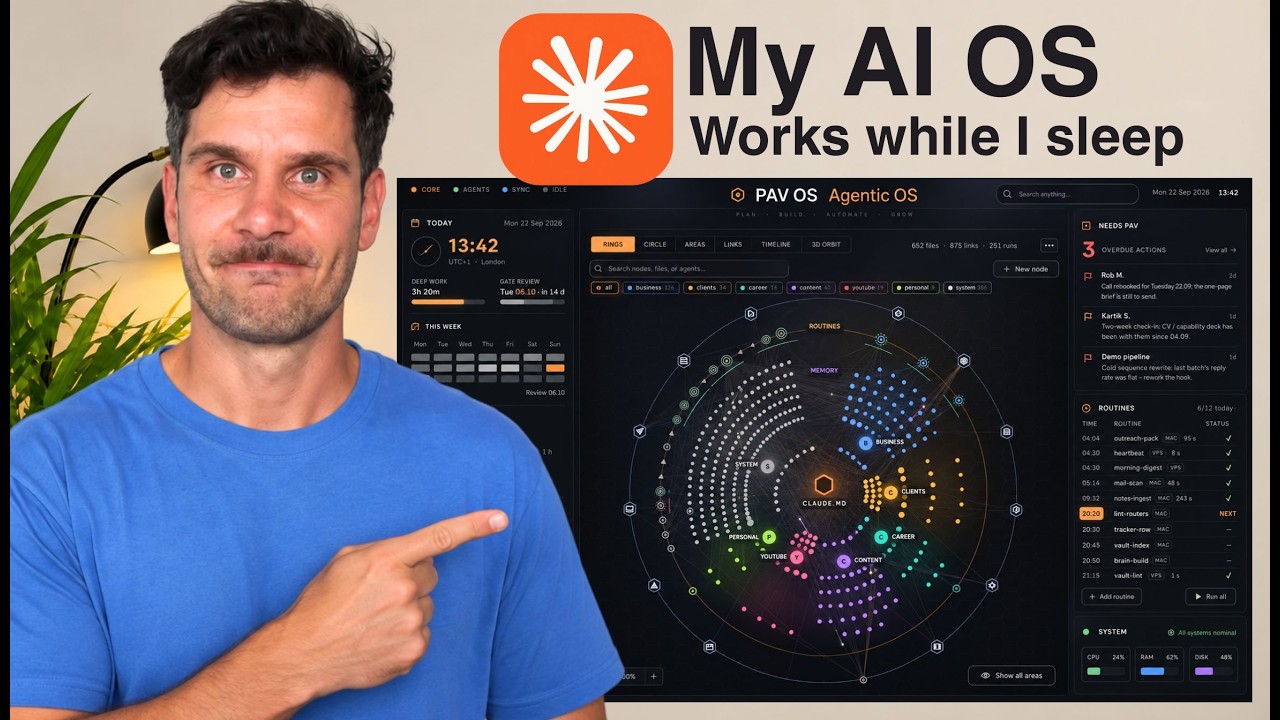
Open Montage: FREE Open-Source Agentic Video System!
This video demos Open Montage, an open-source agentic video production system (24,000 GitHub stars) that turns an AI coding assistant into a full studio: you give it one sentence and it researches, scripts, films each shot via APIs like Fal, Nano Banana, or GPT image stills, and edits a cinematic short film using the Remotion skill. It also covers a cinematic-stills fallback that needs no video API and how the host wires it into an agent dashboard with shared memory.
Julian Goldie SEO10 minTranscript found
Quick learning frame
Read this before watching.
Creative automation accelerates production while keeping human taste in brief, source selection, generation, editing, and critique.
New playlist item from Julian Goldie SEO; queued for transcript-backed review, topic mapping, and a practical learning artifact.
Skill you build: The ability to set up an agentic one-prompt video pipeline — choosing between full video generation and cinematic-stills modes, plugging in the right image/video APIs (or none), and driving it from an agent system that already knows your brand.
Watch for the shift from claim to mechanism. The learning value is the point where the transcript reveals a repeatable action, tool boundary, context move, review habit, or artifact.
Concept diagram
Where this video fits.
01Brief
02Source material
03Generation
04Selection
05Edit
06Taste review
07Reusable recipe
Deep lesson
Turn this video into working knowledge.
2,139 cleaned transcript words reviewed across 598 timed caption segments.
Thesis
Open Montage: FREE Open-Source Agentic Video System! teaches a practical creative automation move: This video demos Open Montage, an open-source agentic video production system (24,000 GitHub stars) that turns an AI coding assistant into a full studio: you give it one sentence and it researches, scripts, films each shot via APIs like Fal, Nano Banana, or GPT image stills, and edits a cinematic short film using the Remotion skill. It also covers a cinematic-stills fallback that needs no video API and how the host wires it into an agent dashboard with shared memory.
The goal is not to remember the video. The goal is to extract the operating principle, tie it to timestamped evidence, test how far the claim transfers, and make something reusable.
0:00
One-click movie agent
“Today, we're going to be looking at Open Montage, which is the world's first open-source agentic video production system. Let me show you what we've created with this cuz this is absolutely mind-blowing. So, you can see an...”
Open Montage plugs into the host's mission-control dashboard so a single click generates a complete film — script, sound, story, and edit — and it can run in two modes: cinematic stills stitched together, or true per-scene video generation, with no step-by-step prompting because you just type the movie idea. Write three one-sentence movie ideas for your own niche and note which of the two modes (stills vs per-scene video) you would pick for each and why.
4:16
APIs and Remotion
“simple prompts that were created here. So, if you look at the prompts for each of these stories that were created, very very simple, just like one line, and it creates a whole thing. I'm sure if you...”
You can power it with Nano Banana (used for the GitHub founder's film The Last Banana), OpenAI stills, or the host's favorite, a Fal API key for direct video generation; a separate skill called Remotion lays the storyline titles over the top, and the whole thing is open source and free to start, with optional sound. If you skip video APIs entirely, GPT image 2 stills still get cinematic camera motion, dramatic titles, and color grading. Clone the Open Montage repo, pick one provider (Fal key or the free no-API-key Remotion/Hyperframes path), and generate a single short film from one sentence to see the pipeline end to end.
7:44
Agent-driven pipeline
“then you can go from there. Now, if you want to make Open Montage part of a system that actually knows you, your business, and everything else, we've plugged this into our Agent Operating System, so it even...”
The system routes one prompt through research, scripting, generation, and editing, picking the best tool for each step and logging why in the back end; it can mix in real footage, shows per-prompt API costs, and — per the host — is only as good as the agent driving it, which is why he connects it to an Agent Operating System with shared memory so the video agent already knows his brand, voice, and goals. Draft a short brand-context brief (voice, goals, visual style) you would give the driving agent before it generates videos, so outputs match your business instead of generic cinema.
01
Brief
Start with this video's job: This video demos Open Montage, an open-source agentic video production system (24,000 GitHub stars) that turns an AI coding assistant into a full studio: you give it one sentence and it researches, scripts, films each shot via APIs like Fal, Nano Banana, or GPT image stills, and edits a cinematic short film using the Remotion skill. It also covers a cinematic-stills fallback that needs no video API and how the host wires it into an agent dashboard with shared memory. Treat "Brief" as the outcome you are trying to make visible, not a topic label. Anchor it to 0:00, where the video says: “Today, we're going to be looking at Open Montage, which is the world's first open-source agentic video production system. Let me show you what we've created with this cuz this is absolutely mind-blowing. So, you can see an...”
02
Source material
Use "Source material" to locate the part of the creative automation mechanism the video is demonstrating. Ask what changes in your real setup if this claim is true. Anchor it to 4:16, where the video says: “simple prompts that were created here. So, if you look at the prompts for each of these stories that were created, very very simple, just like one line, and it creates a whole thing. I'm sure if you...”
03
Generation
Turn "Generation" into the reusable artifact for this lesson: A creative production board with source inputs, prompt recipe, selection criteria, edit pass, and taste-review checkpoints. This is where watching becomes something you can inspect and reuse.
04
Selection
Use "Selection" as the application surface. Decide whether the idea touches a browser flow, a local file, a model choice, a source document, a UI, or a review step.
05
Edit
Use "Edit" to prove the lesson. The evidence should connect back to the video title, transcript anchors, and a concrete output, not a generic best-practice claim.
06
Taste review
Use "Taste review" to carry the idea forward: save the prompt, checklist, diagram, or operating rule that would make the next agent run better.
07
Reusable recipe
Connect "Reusable recipe" to Open Montage: FREE Open-Source Agentic Video System! by naming the claim, the evidence, and the artifact it should produce.
Example
Source-backed artifact packet
Convert the video into a scoped artifact request that includes the transcript claim, mechanism, acceptance criteria, and proof. The output should be a creative production board with source inputs, prompt recipe, selection criteria, edit pass, and taste-review checkpoints..
Example
Creative automation proof brief
Separate what the speaker claims, what the demo actually proves, and what still needs outside verification before you adopt the creative automation pattern.
Example
Teach-back module
Transform the lesson into a definition, a Brief -> Source material -> Generation -> Selection -> Edit -> Taste review -> Reusable recipe diagram, one misconception, one practice exercise, and a check-for-understanding question.
Do not learn it wrong
Treating the title as the lesson without checking what the transcript actually says.
mistaking novelty for quality
no source/brief discipline
shipping generated media without taste review
Letting the lesson drift into generic content advice.
Letting the lesson drift into tool hype.
Letting the lesson drift into creative output without selection criteria.
Do not count this as learned until these are true.
01
State the transcript-backed claim in your own words: This video demos Open Montage, an open-source agentic video production system (24,000 GitHub stars) that turns an AI coding assistant into a full studio: you give it one sentence and it researches, scripts, films each shot via APIs like Fal, Nano Banana, or GPT image stills, and edits a cinematic short film using the Remotion skill. It also covers a cinematic-stills fallback that needs no video API and how the host wires it into an agent dashboard with shared memory.
02
Explain the practical stakes without hype: New playlist item from Julian Goldie SEO; queued for transcript-backed review, topic mapping, and a practical learning artifact.
03
Map the idea onto the Brief -> Source material -> Generation -> Selection -> Edit -> Taste review -> Reusable recipe sequence and name the weakest link.
04
Produce the artifact and include the evidence that proves it: A creative production board with source inputs, prompt recipe, selection criteria, edit pass, and taste-review checkpoints.
Put it into practice
Give this grounded prompt to Codex or Claude after watching.
You are helping me turn one specific YouTube video into real, durable learning.

Source video:
- Title: Open Montage: FREE Open-Source Agentic Video System!
- URL: https://www.youtube.com/watch?v=kHjROFbd7J4
- Topic: Creative Automation
- My current learning frame: Install Open Montage, run the same one-sentence movie idea through both the cinematic-stills mode and the full video-API mode, then compare quality and logged per-step tool choices and API costs to decide your default production setup.
- Why this matters: New playlist item from Julian Goldie SEO; queued for transcript-backed review, topic mapping, and a practical learning artifact.

Transcript anchors from this exact video:
- 0:00 / Evidence 1: "Today, we're going to be looking at Open Montage, which is the world's first open-source agentic video production system. Let me show you what we've created with this cuz this is absolutely mind-blowing. So, you can see an..."
- 2:31 / Evidence 2: "right now, and you can basically turn your AI coding assistant into a full production video studio, which is pretty cool in itself. You could also teach the skills that this has to any of your agents. So,..."
- 4:16 / Evidence 3: "simple prompts that were created here. So, if you look at the prompts for each of these stories that were created, very very simple, just like one line, and it creates a whole thing. I'm sure if you..."
- 5:49 / Evidence 4: "which is pretty nice. So, how does this work? Well, you type in one prompt, we plug it into our agent operating system already. So, you type in one prompt, and then from there it does the research,..."
- 7:44 / Evidence 5: "then you can go from there. Now, if you want to make Open Montage part of a system that actually knows you, your business, and everything else, we've plugged this into our Agent Operating System, so it even..."
- 9:18 / Evidence 6: "the rest of the community as well, which is awesome. And you can see the sort of stuff we're getting here. Like, for example, hoping was saying how the system that we've given with the Agent OS, they..."

Video-aware target:
- Prompt lane: Creative automation
- Mechanism to extract: Extract the creative production loop, especially where the human keeps taste, selection, and final judgment.
- Artifact to produce: A creative production board with source inputs, prompt recipe, selection criteria, edit pass, and taste-review checkpoints.
- Artifact must include: brief; source inputs; generation recipe; selection criteria; edit/review checkpoint

Your task:
1. Use the transcript anchors above as the primary source packet. If you add outside context, label it clearly as outside context and keep it secondary.
2. Create a source-check table with columns: timestamp, claim, transcript support, what the demo proves, confidence, and what still needs verification.
3. Extract the actual teachable mechanism from the video: Extract the creative production loop, especially where the human keeps taste, selection, and final judgment. Do not invent claims that are not supported by the title, lesson frame, or transcript anchors.
4. Build a reusable learning artifact: A creative production board with source inputs, prompt recipe, selection criteria, edit pass, and taste-review checkpoints.
5. Include:
   - a plain-English definition of the core idea
   - a diagram or structured model using this sequence: Brief -> Source material -> Generation -> Selection -> Edit -> Taste review -> Reusable recipe
   - answers to these source questions: What asset is being produced? | What inputs and tools drive it? | Where does human taste intervene?
   - 3 concrete examples that apply the video idea to real agentic work, such as Claude-generated video campaign; image-to-site workflow; voice or video editing loop
   - 2 failure modes the video helps prevent, chosen from the transcript evidence and these likely risks: mistaking novelty for quality; no source/brief discipline; shipping generated media without taste review
   - a checklist for the next real workflow, focused on: brief, inputs, generation, selection, critique
   - one practical exercise with a clear done signal: Build one reusable creative recipe and define what would make the result rejectable.
6. Add a "learning transfer" section: what changes in my workflow tomorrow if I actually learned this?
7. Add a "source check" section that cites which transcript anchor supports each major takeaway.

Quality bar:
- Make this specific to "Open Montage: FREE Open-Source Agentic Video System!", not a generic Creative Automation essay.
- Anchor each creative step to transcript evidence about inputs, model/tool choices, iteration, editing, or critique.
- Prefer operational examples, failure modes, and reusable artifacts over broad definitions.
- Call out uncertainty instead of smoothing over weak evidence.
- Avoid these generic drifts: generic content advice; tool hype; creative output without selection criteria.
- If evidence is weak or missing, stop and say what transcript segment or timestamp needs review instead of guessing.
- Finish with a concise artifact I could paste into my learning app.
Misconceptions
What to stop believing.
Creative AI removes the need for taste.
It increases the need for taste because output volume explodes.
The best prompt is enough.
References, critique, iteration, and post-production matter just as much.
Practice studio
Learning only counts when you make something.
01
Transcript evidence map
Separate what the video actually says from what you already believe about the topic.
3 source-backed takeaways with timestamps, confidence, and a transfer note.02
One useful artifact
Apply the video to a real workflow and produce a creative production board with source inputs, prompt recipe, selection criteria, edit pass, and taste-review checkpoints..
A reusable artifact with a done signal and one verification step.03
Creative automation teach-back card
Explain the creative automation mechanism to someone who has not watched the video yet.
A 90-second explanation, one diagram, one example, and one misconception to avoid.
Recall check
Answer first, then reveal — without rewatching.
What are the two generation modes Open Montage can switch between when producing a film?
Which APIs and skills does the video mention for powering Open Montage, and what does Remotion do?
What happens behind the scenes when you give the agent-driven pipeline a single plain-sentence prompt?
Source shelf
Use the video as a doorway, then verify with primary sources.