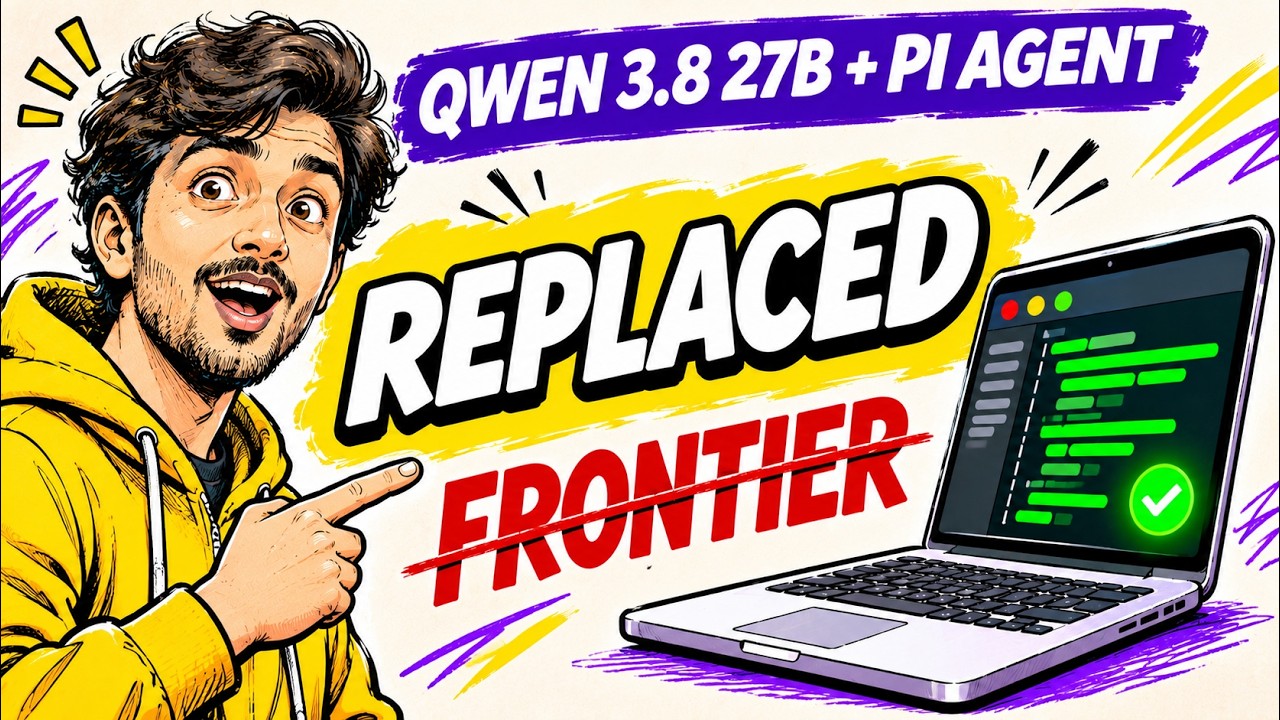
This month-long review explains T3 Code as an open-source control room that runs existing coding-agent harnesses and subscriptions through one desktop interface. It examines multi-account and cross-provider handoffs, orchestrated subagents, worktrees, remote access, release channels, and the thread-status bugs that remain when deciding whether the tool fits a multi-plan workflow.
Thomas Bekkers22 minTranscript found
Quick learning frame
Read this before watching.
Coding-agent workflow is the loop of inspect, route, plan, edit, verify, summarize, and decide what should be automated next.
New playlist item from Thomas Bekkers; queued for transcript-backed review, topic mapping, and a practical learning artifact.
Skill you build: The ability to evaluate and configure a unified AI-agent workspace by distinguishing models, harnesses, and control interfaces and weighing orchestration benefits against operational bugs.
Watch for the shift from claim to mechanism. The learning value is the point where the transcript reveals a repeatable action, tool boundary, context move, review habit, or artifact.
Concept diagram
Where this video fits.
01Inspect context
02Route tool
03Plan work
04Edit safely
05Verify behavior
06Report next step
Deep lesson
Turn this video into working knowledge.
5,245 cleaned transcript words reviewed across 1,406 timed caption segments.
Thesis
T3 Code After a Month: My Honest Review teaches a practical coding-agent workflow move: This month-long review explains T3 Code as an open-source control room that runs existing coding-agent harnesses and subscriptions through one desktop interface. It examines multi-account and cross-provider handoffs, orchestrated subagents, worktrees, remote access, release channels, and the thread-status bugs that remain when deciding whether the tool fits a multi-plan workflow.
The goal is not to remember the video. The goal is to extract the operating principle, tie it to timestamped evidence, test how far the claim transfers, and make something reusable.
0:56
Garage, Not Harness
“anthropics coding agent lives in its own app or its own terminal window. Codex from openi lives in its own app. Grock build has its own app etc etc. Each one of those is tied to its own...”
A model is the engine that reads and writes text, while a harness such as Claude Code or Codex gives it tools, rules, and a loop for acting and checking work. T3 Code is the garage or dashboard above those harnesses: it launches the real tools underneath, keeps their existing subscriptions, and inherits their improvements rather than supplying its own AI plan. Draw a three-layer diagram for your current setup that names each model, the harness that gives it tools and permissions, and the interface from which you control it.
9:44
Orchestrate Across Providers
“7-day limit finishes, so I kind of balance it that way. Ultimately, you can do it how you want, but again, you don't always need the smartest model. So, you can use a sub agent to a lot...”
T3 Code can hand a thread from one provider to another with a briefing containing the original request, recent messages, commands, changed files, and a way to retrieve older context. Its orchestrator also lets a boss thread delegate to subagents on different models, plans, or accounts, receive their results, centralize permission requests, and stop the whole group from the main thread. Design a boss-and-subagent workflow for one project, assigning planning to a strong model and two bounded execution tasks to cheaper or less-used plans, with explicit permission checkpoints.
19:29
Judge Operational Friction
“terra 6.1 model with computer use like everything is just done through one single thread that I have skills for and different models and different sub agents are doing it again all in T3 code all the work...”
The stable channel favors tested releases, while nightly ships the newest code several times a day with greater risk of fresh bugs. The review's main irritation is inaccurate thread state: finished work can remain under working, active work can appear finished, and connection blips can move threads between columns, with occasional account switches also producing a no-conversation-found error. Run a short evaluation with several concurrent threads and record whether working, finished, and settled states remain accurate after completion, reconnection, and an account switch.
01
Inspect context
Start with this video's job: This month-long review explains T3 Code as an open-source control room that runs existing coding-agent harnesses and subscriptions through one desktop interface. It examines multi-account and cross-provider handoffs, orchestrated subagents, worktrees, remote access, release channels, and the thread-status bugs that remain when deciding whether the tool fits a multi-plan workflow. Treat "Inspect context" as the outcome you are trying to make visible, not a topic label. Anchor it to 0:56, where the video says: “anthropics coding agent lives in its own app or its own terminal window. Codex from openi lives in its own app. Grock build has its own app etc etc. Each one of those is tied to its own...”
02
Route tool
Use "Route tool" to locate the part of the coding-agent workflow mechanism the video is demonstrating. Ask what changes in your real setup if this claim is true. Anchor it to 9:44, where the video says: “7-day limit finishes, so I kind of balance it that way. Ultimately, you can do it how you want, but again, you don't always need the smartest model. So, you can use a sub agent to a lot...”
03
Plan work
Turn "Plan work" into the reusable artifact for this lesson: A coding-agent routing and execution matrix with context needed, tool choice, verification, and done signal. This is where watching becomes something you can inspect and reuse.
04
Edit safely
Use "Edit safely" as the application surface. Decide whether the idea touches a browser flow, a local file, a model choice, a source document, a UI, or a review step.
05
Verify behavior
Use "Verify behavior" to prove the lesson. The evidence should connect back to the video title, transcript anchors, and a concrete output, not a generic best-practice claim.
06
Report next step
Use "Report next step" to carry the idea forward: save the prompt, checklist, diagram, or operating rule that would make the next agent run better.
Example
Source-backed artifact packet
Convert the video into a scoped artifact request that includes the transcript claim, mechanism, acceptance criteria, and proof. The output should be a coding-agent routing and execution matrix with context needed, tool choice, verification, and done signal..
Example
Coding-agent workflow proof brief
Separate what the speaker claims, what the demo actually proves, and what still needs outside verification before you adopt the coding-agent workflow pattern.
Example
Teach-back module
Transform the lesson into a definition, a Inspect context -> Route tool -> Plan work -> Edit safely -> Verify behavior -> Report next step diagram, one misconception, one practice exercise, and a check-for-understanding question.
Do not learn it wrong
Treating the title as the lesson without checking what the transcript actually says.
choosing tools by hype
losing context across agents
letting parallel sessions become invisible
Letting the lesson drift into generic Codex vs Claude comparison.
Letting the lesson drift into feature lists without task routing.
Letting the lesson drift into claims that ignore limits or recovery.
Do not count this as learned until these are true.
01
State the transcript-backed claim in your own words: This month-long review explains T3 Code as an open-source control room that runs existing coding-agent harnesses and subscriptions through one desktop interface. It examines multi-account and cross-provider handoffs, orchestrated subagents, worktrees, remote access, release channels, and the thread-status bugs that remain when deciding whether the tool fits a multi-plan workflow.
02
Explain the practical stakes without hype: New playlist item from Thomas Bekkers; queued for transcript-backed review, topic mapping, and a practical learning artifact.
03
Map the idea onto the Inspect context -> Route tool -> Plan work -> Edit safely -> Verify behavior -> Report next step sequence and name the weakest link.
04
Produce the artifact and include the evidence that proves it: A coding-agent routing and execution matrix with context needed, tool choice, verification, and done signal.
Put it into practice
Give this grounded prompt to Codex or Claude after watching.
You are helping me turn one specific YouTube video into real, durable learning.

Source video:
- Title: T3 Code After a Month: My Honest Review
- URL: https://www.youtube.com/watch?v=4UDDTPGRmCg
- Topic: Creative Automation
- My current learning frame: Map your models, harnesses, subscriptions, and machines, then prototype one cross-provider boss-and-subagent workflow and score it on handoff continuity, permission visibility, thread-state accuracy, and time saved switching accounts.
- Why this matters: New playlist item from Thomas Bekkers; queued for transcript-backed review, topic mapping, and a practical learning artifact.

Transcript anchors from this exact video:
- 0:56 / Evidence 1: "anthropics coding agent lives in its own app or its own terminal window. Codex from openi lives in its own app. Grock build has its own app etc etc. Each one of those is tied to its own..."
- 4:34 / Evidence 2: "the Codex app and Claude Code just can't because each one of those only runs on its own company's models. So, I'm going to show you a couple of those first and I'm going to show you the..."
- 6:36 / Evidence 3: "Same with Codex, same with Grock Build. Again, super easy once you got it set up. Once you have the provider set up, one click, you can switch between all these plans. And if you kind of see..."
- 9:44 / Evidence 4: "7-day limit finishes, so I kind of balance it that way. Ultimately, you can do it how you want, but again, you don't always need the smartest model. So, you can use a sub agent to a lot..."
- 11:56 / Evidence 5: "the project. And then the next one is the built-in browser. So, Codex has one, Cloud Code has another one. I think most desktop apps have it at this point. Essentially, it is an integrated browser in the..."
- 13:40 / Evidence 6: "this crap? Why would anybody make something open source when cloud code and Codex or or Frontier Labs already making things like this? And I just hated the whole concept of it. And like I said, it was..."
- 19:29 / Evidence 7: "terra 6.1 model with computer use like everything is just done through one single thread that I have skills for and different models and different sub agents are doing it again all in T3 code all the work..."

Video-aware target:
- Prompt lane: Coding-agent workflow
- Mechanism to extract: Find the workflow rule that explains when and how to use Codex, Claude Code, browser control, dashboards, or manual review.
- Artifact to produce: A coding-agent routing and execution matrix with context needed, tool choice, verification, and done signal.
- Artifact must include: task class; agent/tool choice; context packet; verification step; handoff/recovery rule

Your task:
1. Use the transcript anchors above as the primary source packet. If you add outside context, label it clearly as outside context and keep it secondary.
2. Create a source-check table with columns: timestamp, claim, transcript support, what the demo proves, confidence, and what still needs verification.
3. Extract the actual teachable mechanism from the video: Find the workflow rule that explains when and how to use Codex, Claude Code, browser control, dashboards, or manual review. Do not invent claims that are not supported by the title, lesson frame, or transcript anchors.
4. Build a reusable learning artifact: A coding-agent routing and execution matrix with context needed, tool choice, verification, and done signal.
5. Include:
   - a plain-English definition of the core idea
   - a diagram or structured model using this sequence: Inspect context -> Route tool -> Plan work -> Edit safely -> Verify behavior -> Report next step
   - answers to these source questions: What workflow pain is being solved? | What exact coordination mechanism is shown? | What evidence proves it changes the work?
   - 3 concrete examples that apply the video idea to real agentic work, such as rate-limit routing; browser verification after a UI edit; long-running /goal session review
   - 2 failure modes the video helps prevent, chosen from the transcript evidence and these likely risks: choosing tools by hype; losing context across agents; letting parallel sessions become invisible
   - a checklist for the next real workflow, focused on: routing decision, context portability, verification, handoff summary
   - one practical exercise with a clear done signal: Route three recent tasks across Codex, Claude, browser checks, and manual review with a reason for each.
6. Add a "learning transfer" section: what changes in my workflow tomorrow if I actually learned this?
7. Add a "source check" section that cites which transcript anchor supports each major takeaway.

Quality bar:
- Make this specific to "T3 Code After a Month: My Honest Review", not a generic Creative Automation essay.
- Each workflow rule must point to a timestamped claim or demo moment, then state what remains unproven.
- Prefer operational examples, failure modes, and reusable artifacts over broad definitions.
- Call out uncertainty instead of smoothing over weak evidence.
- Avoid these generic drifts: generic Codex vs Claude comparison; feature lists without task routing; claims that ignore limits or recovery.
- If evidence is weak or missing, stop and say what transcript segment or timestamp needs review instead of guessing.
- Finish with a concise artifact I could paste into my learning app.
Misconceptions
What to stop believing.
Creative AI removes the need for taste.
It increases the need for taste because output volume explodes.
The best prompt is enough.
References, critique, iteration, and post-production matter just as much.
Practice studio
Learning only counts when you make something.
01
Transcript evidence map
Separate what the video actually says from what you already believe about the topic.
3 source-backed takeaways with timestamps, confidence, and a transfer note.02
One useful artifact
Apply the video to a real workflow and produce a coding-agent routing and execution matrix with context needed, tool choice, verification, and done signal..
A reusable artifact with a done signal and one verification step.03
Coding-agent workflow teach-back card
Explain the coding-agent workflow mechanism to someone who has not watched the video yet.
A 90-second explanation, one diagram, one example, and one misconception to avoid.
Recall check
Answer first, then reveal — without rewatching.
How does T3 Code differ from an AI model and a coding-agent harness?
What context is passed when a thread switches from one provider to another?
What is the reviewer's main bug with T3 Code's status columns?
Source shelf
Use the video as a doorway, then verify with primary sources.