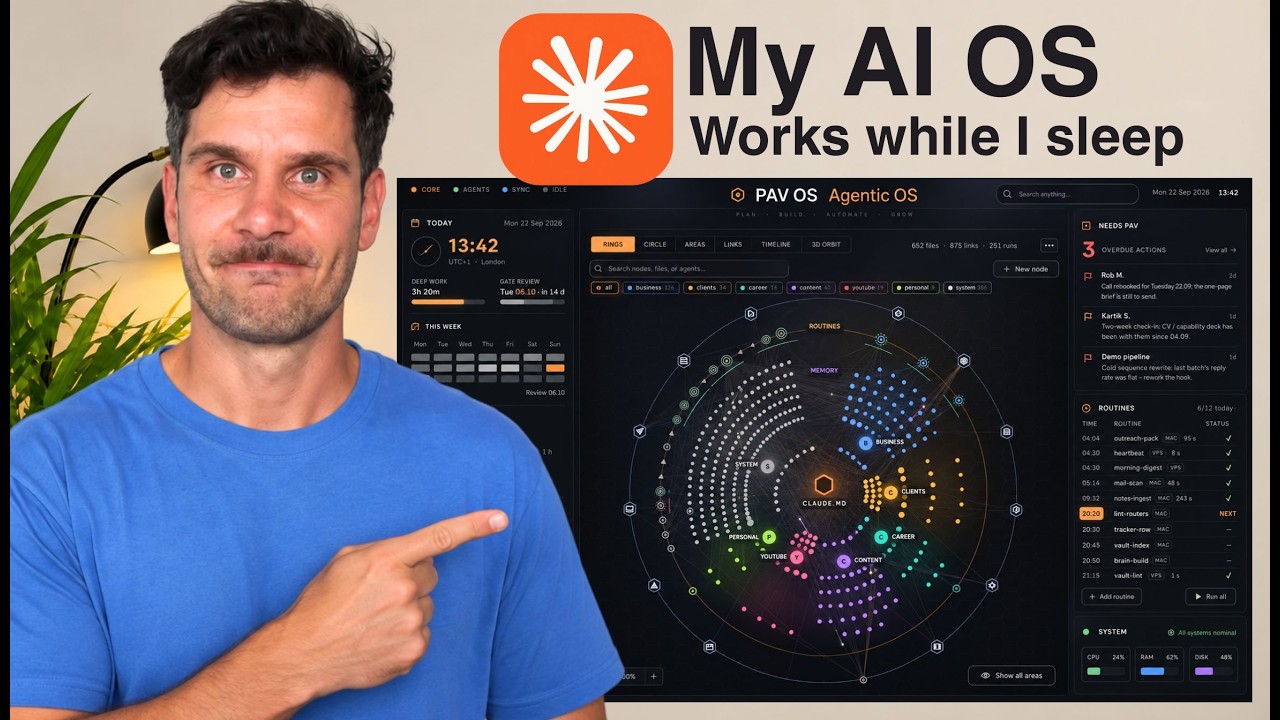
This video argues that a Claude Code 'agentic OS' lives or dies on its skill-and-automation backbone, and walks through building that backbone first, then adding an Obsidian memory layer and an Obsidian-or-Streamlit dashboard on top.
Chase AI20 minTranscript found
Quick learning frame
Read this before watching.
A context/search lesson is about getting the right evidence into the agent at the right time through indexes, search, memory, or knowledge graphs.
New playlist item from Chase AI; queued for transcript-backed review, topic mapping, and a practical learning artifact.
Skill you build: The ability to convert your recurring day-to-day workflows into codified, testable Claude Code skills and decide when each becomes a local or cloud automation, before investing in any dashboard layer.
Watch for the shift from claim to mechanism. The learning value is the point where the transcript reveals a repeatable action, tool boundary, context move, review habit, or artifact.
Concept diagram
Where this video fits.
01Work question
02Source inventory
03Index/search layer
04Retrieval rule
05Agent context
06Answer/proof
07Maintenance
Deep lesson
Turn this video into working knowledge.
4,115 cleaned transcript words reviewed across 1,148 timed caption segments.
Thesis
Your Claude Code Agentic OS Sucks teaches a practical context/search move: This video argues that a Claude Code 'agentic OS' lives or dies on its skill-and-automation backbone, and walks through building that backbone first, then adding an Obsidian memory layer and an Obsidian-or-Streamlit dashboard on top.
The goal is not to remember the video. The goal is to extract the operating principle, tie it to timestamped evidence, test how far the claim transfers, and make something reusable.
1:04
Backbone over dashboards
“workflows and tasks, turn those into skills, turn those skills into automations where it makes sense, and in the process build out a cohesive system like you see here. So we can do the same thing over and...”
An agentic OS has three layers (skill/automation backbone, memory layer, dashboard), and value comes only when the backbone is locked in first; flashy command centers are a facade over the skills underneath. List the three layers and honestly mark which one you've actually built versus which one you've been polishing for show.
6:25
Codify tasks into skills
“lot of the tasks we do into quote unquote like workflow skills or higher order skills that have it do a bunch of different things at once. For example, I have a skill called the content cascade skill.”
Codifying a repeated workflow into a skill gives convenience (one word triggers it), testability (skill-creator A/B benchmarks skill-vs-no-skill), and more deterministic outputs from a non-deterministic LLM; higher-order 'workflow skills' like a content-cascade bundle many tasks into one. Open the terminal, narrate one real daily workflow to Claude, and ask it to extract skills, then benchmark one with the skill-creator skill.
12:54
Obsidian as index layer
“vault and I click on the wiki folder, inside the wiki folder is a table of context called an index file, which tells me, oh, inside here we have agents, rag systems, and content creation wiks. Cool. I...”
Obsidian isn't RAG or a real knowledge graph; it's a human organization layer whose real payoff is master/index files at every folder level (the Karpathy raw/wiki/outputs idea) so you and Claude can navigate 100k files token-efficiently. Design a folder scheme that fits your own work and add an index 'table of contents' file at each level so navigation scales past 5,000 documents.
01
Work question
Start with this video's job: This video argues that a Claude Code 'agentic OS' lives or dies on its skill-and-automation backbone, and walks through building that backbone first, then adding an Obsidian memory layer and an Obsidian-or-Streamlit dashboard on top. Treat "Work question" as the outcome you are trying to make visible, not a topic label. Anchor it to 1:04, where the video says: “workflows and tasks, turn those into skills, turn those skills into automations where it makes sense, and in the process build out a cohesive system like you see here. So we can do the same thing over and...”
02
Source inventory
Use "Source inventory" to locate the part of the context/search mechanism the video is demonstrating. Ask what changes in your real setup if this claim is true. Anchor it to 6:25, where the video says: “lot of the tasks we do into quote unquote like workflow skills or higher order skills that have it do a bunch of different things at once. For example, I have a skill called the content cascade skill.”
03
Index/search layer
Turn "Index/search layer" into the reusable artifact for this lesson: A context retrieval map with source inventory, indexing/search path, query rules, freshness checks, and agent handoff. This is where watching becomes something you can inspect and reuse.
04
Retrieval rule
Use "Retrieval rule" as the application surface. Decide whether the idea touches a browser flow, a local file, a model choice, a source document, a UI, or a review step.
05
Agent context
Use "Agent context" to prove the lesson. The evidence should connect back to the video title, transcript anchors, and a concrete output, not a generic best-practice claim.
06
Answer/proof
Use "Answer/proof" to carry the idea forward: save the prompt, checklist, diagram, or operating rule that would make the next agent run better.
07
Maintenance
Connect "Maintenance" to Your Claude Code Agentic OS Sucks by naming the claim, the evidence, and the artifact it should produce.
Example
Source-backed artifact packet
Convert the video into a scoped artifact request that includes the transcript claim, mechanism, acceptance criteria, and proof. The output should be a context retrieval map with source inventory, indexing/search path, query rules, freshness checks, and agent handoff..
Example
Context/search proof brief
Separate what the speaker claims, what the demo actually proves, and what still needs outside verification before you adopt the context/search pattern.
Example
Teach-back module
Transform the lesson into a definition, a Work question -> Source inventory -> Index/search layer -> Retrieval rule -> Agent context -> Answer/proof -> Maintenance diagram, one misconception, one practice exercise, and a check-for-understanding question.
Do not learn it wrong
Treating the title as the lesson without checking what the transcript actually says.
dumping all context
stale memory
retrieval with no proof trail
Letting the lesson drift into generic context-window advice.
Letting the lesson drift into memory hype without retrieval rules.
Letting the lesson drift into source claims without freshness checks.
Do not count this as learned until these are true.
01
State the transcript-backed claim in your own words: This video argues that a Claude Code 'agentic OS' lives or dies on its skill-and-automation backbone, and walks through building that backbone first, then adding an Obsidian memory layer and an Obsidian-or-Streamlit dashboard on top.
02
Explain the practical stakes without hype: New playlist item from Chase AI; queued for transcript-backed review, topic mapping, and a practical learning artifact.
03
Map the idea onto the Work question -> Source inventory -> Index/search layer -> Retrieval rule -> Agent context -> Answer/proof -> Maintenance sequence and name the weakest link.
04
Produce the artifact and include the evidence that proves it: A context retrieval map with source inventory, indexing/search path, query rules, freshness checks, and agent handoff.
Put it into practice
Give this grounded prompt to Codex or Claude after watching.
You are helping me turn one specific YouTube video into real, durable learning.

Source video:
- Title: Your Claude Code Agentic OS Sucks
- URL: https://www.youtube.com/watch?v=d86VCtQ_dN8
- Topic: Creative Automation
- My current learning frame: Pick one domain of your daily work, narrate it to Claude Code in a fresh session, extract and benchmark at least one skill, then classify it as on-demand, local automation, or cloud automation.
- Why this matters: New playlist item from Chase AI; queued for transcript-backed review, topic mapping, and a practical learning artifact.

Transcript anchors from this exact video:
- 1:04 / Evidence 1: "workflows and tasks, turn those into skills, turn those skills into automations where it makes sense, and in the process build out a cohesive system like you see here. So we can do the same thing over and..."
- 3:02 / Evidence 2: "just released the Claude code masterass, which is the number one way to go from zero to AI dev, but I have also just added an Aentic OS masterass inside as well. So, everything you see in today's..."
- 4:45 / Evidence 3: "codifying this into a skill? Because when we codify it into a skill, there's a few things that gives us. One, it's convenient. I'm taking that entire task and instead of talking about it over the course of..."
- 6:25 / Evidence 4: "lot of the tasks we do into quote unquote like workflow skills or higher order skills that have it do a bunch of different things at once. For example, I have a skill called the content cascade skill."
- 10:43 / Evidence 5: "applies to something like Codex. Now let's talk about Obsidian and memory very quickly before we dive into the command center observability dashboard piece because I think a lot of people get confused about what Obsidian's actually buying..."
- 12:54 / Evidence 6: "vault and I click on the wiki folder, inside the wiki folder is a table of context called an index file, which tells me, oh, inside here we have agents, rag systems, and content creation wiks. Cool. I..."
- 16:24 / Evidence 7: "of do it because this whole dashboard command center is essentially just a custom plugin that Claude Code created. But it's a little more again clunky and awkward to set this up for somebody else. It's not just..."

Video-aware target:
- Prompt lane: Context/search
- Mechanism to extract: Extract how context is found, filtered, refreshed, and handed to the agent before it acts.
- Artifact to produce: A context retrieval map with source inventory, indexing/search path, query rules, freshness checks, and agent handoff.
- Artifact must include: source inventory; index/search layer; query rule; freshness check; agent handoff; proof behavior

Your task:
1. Use the transcript anchors above as the primary source packet. If you add outside context, label it clearly as outside context and keep it secondary.
2. Create a source-check table with columns: timestamp, claim, transcript support, what the demo proves, confidence, and what still needs verification.
3. Extract the actual teachable mechanism from the video: Extract how context is found, filtered, refreshed, and handed to the agent before it acts. Do not invent claims that are not supported by the title, lesson frame, or transcript anchors.
4. Build a reusable learning artifact: A context retrieval map with source inventory, indexing/search path, query rules, freshness checks, and agent handoff.
5. Include:
   - a plain-English definition of the core idea
   - a diagram or structured model using this sequence: Work question -> Source inventory -> Index/search layer -> Retrieval rule -> Agent context -> Answer/proof -> Maintenance
   - answers to these source questions: What source is searched or indexed? | What query/retrieval rule is demonstrated? | How does the agent use the retrieved context?
   - 3 concrete examples that apply the video idea to real agentic work, such as codebase memory; personal wiki retrieval; Elastic search context engineering
   - 2 failure modes the video helps prevent, chosen from the transcript evidence and these likely risks: dumping all context; stale memory; retrieval with no proof trail
   - a checklist for the next real workflow, focused on: sources, query, freshness, handoff, citation/proof
   - one practical exercise with a clear done signal: Write three retrieval queries for one real project and define what each must return.
6. Add a "learning transfer" section: what changes in my workflow tomorrow if I actually learned this?
7. Add a "source check" section that cites which transcript anchor supports each major takeaway.

Quality bar:
- Make this specific to "Your Claude Code Agentic OS Sucks", not a generic Creative Automation essay.
- Cite the transcript wherever the prompt names a task boundary, review habit, context move, or verification standard.
- Prefer operational examples, failure modes, and reusable artifacts over broad definitions.
- Call out uncertainty instead of smoothing over weak evidence.
- Avoid these generic drifts: generic context-window advice; memory hype without retrieval rules; source claims without freshness checks.
- If evidence is weak or missing, stop and say what transcript segment or timestamp needs review instead of guessing.
- Finish with a concise artifact I could paste into my learning app.
Misconceptions
What to stop believing.
Creative AI removes the need for taste.
It increases the need for taste because output volume explodes.
The best prompt is enough.
References, critique, iteration, and post-production matter just as much.
Practice studio
Learning only counts when you make something.
01
Transcript evidence map
Separate what the video actually says from what you already believe about the topic.
3 source-backed takeaways with timestamps, confidence, and a transfer note.02
One useful artifact
Apply the video to a real workflow and produce a context retrieval map with source inventory, indexing/search path, query rules, freshness checks, and agent handoff..
A reusable artifact with a done signal and one verification step.03
Context/search teach-back card
Explain the context/search mechanism to someone who has not watched the video yet.
A 90-second explanation, one diagram, one example, and one misconception to avoid.
Recall check
Answer first, then reveal — without rewatching.
The video argues a Claude Code 'agentic OS' has three parts and that you must build them in a specific order. What are the three parts, and which one does it insist must be locked in first and why?
Beyond convenience, what two concrete benefits does the video say you get by codifying a repeated task into a skill rather than just chatting with Claude each time?
The video says Obsidian is NOT doing anything special to your markdown files (no RAG, no vectors, no real knowledge graph). So what is the single most important thing it says to take from the Karpathy structure to keep an agentic OS navigable at scale?
Source shelf
Use the video as a doorway, then verify with primary sources.