You NEED to try these open-source AI projects RIGHT NOW
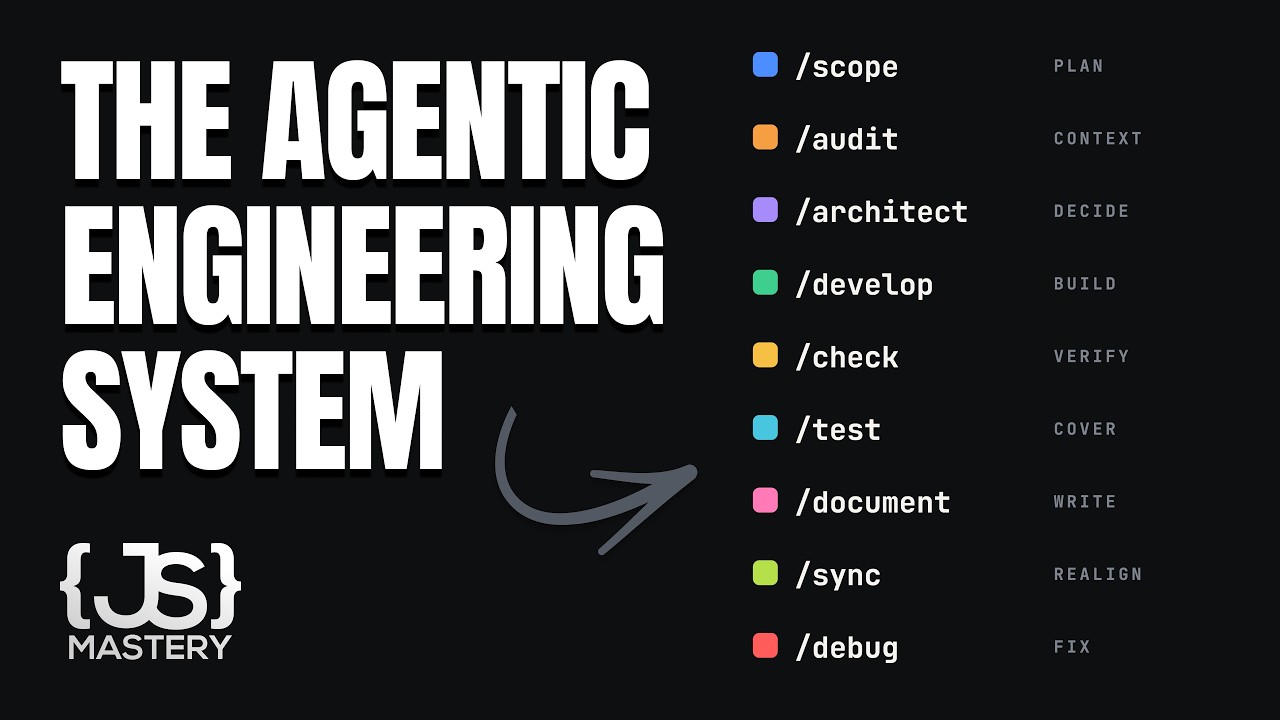
Matthew Berman reviews four under-the-radar open-source projects: Last 30 Days, a human-vote-powered trend search skill; Open Notebook, a local NotebookLM clone with podcast generation; Agent Skills, seven slash-commands mapping the engineering workflow; and Headroom, a context compressor claiming up to ~92% token savings for coding agents.
Matthew Berman16 minTranscript found
Quick learning frame
Read this before watching.
AI strategy chooses where agents create durable leverage, then manages scope, adoption, risk, and measurable outcomes.
New playlist item from Matthew Berman; queued for transcript-backed review, topic mapping, and a practical learning artifact.
Skill you build: The ability to discover, install, and evaluate open-source agent skills and tools — installing them by handing a GitHub URL to your coding agent and verifying their value on your own workflow.
Watch for the shift from claim to mechanism. The learning value is the point where the transcript reveals a repeatable action, tool boundary, context move, review habit, or artifact.
Concept diagram
Where this video fits.
01Use case
02Workflow pain
03Agent role
04Adoption path
05Risk
06Metric
07Pilot
Deep lesson
Turn this video into working knowledge.
2,943 cleaned transcript words reviewed across 842 timed caption segments.
Thesis
You NEED to try these open-source AI projects RIGHT NOW teaches a practical ai strategy move: Matthew Berman reviews four under-the-radar open-source projects: Last 30 Days, a human-vote-powered trend search skill; Open Notebook, a local NotebookLM clone with podcast generation; Agent Skills, seven slash-commands mapping the engineering workflow; and Headroom, a context compressor claiming up to ~92% token savings for coding agents.
The goal is not to remember the video. The goal is to extract the operating principle, tie it to timestamped evidence, test how far the claim transfers, and make something reusable.
0:00
Search by human votes
“I found four free GitHub projects that you probably haven't heard of that are so valuable. The first is a new type of search engine that is completely free, takes zero configuration, and actually works really well. We...”
Last 30 Days (40K+ GitHub stars, by Lyft co-founder Matt Van Horn) is a skill that searches Reddit, Hacker News, Polymarket, GitHub, X, YouTube, and TikTok in parallel, scores results by real human engagement — upvotes, likes, money-backed odds — and has an AI judge synthesize one brief, with an --emit=html option for shareable summaries. Install the skill in your coding agent, run /last30days on a topic you follow, and compare the human-vote-ranked brief against a normal Google search of the same term.
5:40
Local NotebookLM
“fantastic. So, check this out. 11 Agents by 11 Labs is a complete platform to design, deploy, and optimize real-time voice and chat agents that can not only speak, but also understand what you're trying to accomplish and...”
Open Notebook (~30K stars) ingests articles or thousand-page PDFs, answers questions with specific references, generates multi-host customizable podcasts (a 23-minute one from a single essay), and offers transformations like key insights and reflection questions — powered either by hosted models (GPT 5.5 for chat, text-embedding-3-large) or fully locally via Ollama or LM Studio. Install Open Notebook by pasting the repo URL into your agent, load one long document you actually need to read, and generate both a Q&A session and a podcast from it.
10:02
Compress your context
“me. And it's going to give you a step-by-step interview trying to extract exactly what you're looking to build. And it will then structure that in a really nice markdown file that you can then use for the...”
Headroom compresses everything your agent reads — tool outputs, logs, RAG chunks, and history — before it hits the LLM, reporting 92% savings on code search and incident debugging and 47% on codebase exploration with near-perfect accuracy on GSM8K, TruthfulQA, SQuAD v2, and BFCL; it wraps Claude Code via 'headroom wrap claude', shows savings with 'headroom perf', and 'headroom learn' mines failed sessions to write corrections into claude.md. Wrap your coding agent with Headroom (using the no-serena flag and disabling telemetry), work normally for a day, then run headroom perf to measure your actual token savings.
01
Use case
Start with this video's job: Matthew Berman reviews four under-the-radar open-source projects: Last 30 Days, a human-vote-powered trend search skill; Open Notebook, a local NotebookLM clone with podcast generation; Agent Skills, seven slash-commands mapping the engineering workflow; and Headroom, a context compressor claiming up to ~92% token savings for coding agents. Treat "Use case" as the outcome you are trying to make visible, not a topic label. Anchor it to 0:00, where the video says: “I found four free GitHub projects that you probably haven't heard of that are so valuable. The first is a new type of search engine that is completely free, takes zero configuration, and actually works really well. We...”
02
Workflow pain
Use "Workflow pain" to locate the part of the ai strategy mechanism the video is demonstrating. Ask what changes in your real setup if this claim is true. Anchor it to 5:40, where the video says: “fantastic. So, check this out. 11 Agents by 11 Labs is a complete platform to design, deploy, and optimize real-time voice and chat agents that can not only speak, but also understand what you're trying to accomplish and...”
03
Agent role
Turn "Agent role" into the reusable artifact for this lesson: A one-page AI workflow decision memo with use case, leverage claim, risks, metric, and pilot plan. This is where watching becomes something you can inspect and reuse.
04
Adoption path
Use "Adoption path" as the application surface. Decide whether the idea touches a browser flow, a local file, a model choice, a source document, a UI, or a review step.
05
Risk
Use "Risk" to prove the lesson. The evidence should connect back to the video title, transcript anchors, and a concrete output, not a generic best-practice claim.
06
Metric
Use "Metric" to carry the idea forward: save the prompt, checklist, diagram, or operating rule that would make the next agent run better.
07
Pilot
Connect "Pilot" to You NEED to try these open-source AI projects RIGHT NOW by naming the claim, the evidence, and the artifact it should produce.
Example
Source-backed artifact packet
Convert the video into a scoped artifact request that includes the transcript claim, mechanism, acceptance criteria, and proof. The output should be a one-page ai workflow decision memo with use case, leverage claim, risks, metric, and pilot plan..
Example
AI strategy proof brief
Separate what the speaker claims, what the demo actually proves, and what still needs outside verification before you adopt the ai strategy pattern.
Example
Teach-back module
Transform the lesson into a definition, a Use case -> Workflow pain -> Agent role -> Adoption path -> Risk -> Metric -> Pilot diagram, one misconception, one practice exercise, and a check-for-understanding question.
Do not learn it wrong
Treating the title as the lesson without checking what the transcript actually says.
hype laundering
market claims without operational proof
strategy with no pilot
Letting the lesson drift into generic AI business advice.
Letting the lesson drift into unsupported market forecasts.
Letting the lesson drift into no-risk adoption plans.
Do not count this as learned until these are true.
01
State the transcript-backed claim in your own words: Matthew Berman reviews four under-the-radar open-source projects: Last 30 Days, a human-vote-powered trend search skill; Open Notebook, a local NotebookLM clone with podcast generation; Agent Skills, seven slash-commands mapping the engineering workflow; and Headroom, a context compressor claiming up to ~92% token savings for coding agents.
02
Explain the practical stakes without hype: New playlist item from Matthew Berman; queued for transcript-backed review, topic mapping, and a practical learning artifact.
03
Map the idea onto the Use case -> Workflow pain -> Agent role -> Adoption path -> Risk -> Metric -> Pilot sequence and name the weakest link.
04
Produce the artifact and include the evidence that proves it: A one-page AI workflow decision memo with use case, leverage claim, risks, metric, and pilot plan.
Put it into practice
Give this grounded prompt to Codex or Claude after watching.
You are helping me turn one specific YouTube video into real, durable learning.

Source video:
- Title: You NEED to try these open-source AI projects RIGHT NOW
- URL: https://www.youtube.com/watch?v=zjFE-dBzP_E
- Topic: AI Strategy
- My current learning frame: Install all four projects by handing their GitHub URLs to your coding agent, then run one real task through each — a trend search, a document podcast, an /interview-me spec session, and a Headroom-wrapped coding session — and keep the ones that measurably help.
- Why this matters: New playlist item from Matthew Berman; queued for transcript-backed review, topic mapping, and a practical learning artifact.

Transcript anchors from this exact video:
- 0:00 / Evidence 1: "I found four free GitHub projects that you probably haven't heard of that are so valuable. The first is a new type of search engine that is completely free, takes zero configuration, and actually works really well. We..."
- 2:24 / Evidence 2: "engineering was born on June 7th, 2026. And the internet has spent the week fighting about it. Peter Steinberger posted, "You shouldn't be prompting coding agents anymore. You should be designing loops that prompt your agent." and so..."
- 5:40 / Evidence 3: "fantastic. So, check this out. 11 Agents by 11 Labs is a complete platform to design, deploy, and optimize real-time voice and chat agents that can not only speak, but also understand what you're trying to accomplish and..."
- 7:38 / Evidence 4: "bunch of different settings with the podcast generation. You can have multi-host, you can have different tones, you can describe exactly what you want it to sound like. You can change the script. It's all hyper customizable because..."
- 10:02 / Evidence 5: "me. And it's going to give you a step-by-step interview trying to extract exactly what you're looking to build. And it will then structure that in a really nice markdown file that you can then use for the..."
- 11:34 / Evidence 6: "Headroom, and it effectively compresses the context that you are giving to your large language model, and it does so extremely well. Headroom compresses everything your AI agent reads. Tool outputs, logs, rag chunks, files, and conversation history..."
- 14:24 / Evidence 7: "features it has is this thing called headroom learn, which mines failed sessions and writes corrections to claw.md and agents.md. So simply type headroom learn, hit enter, and it's going to start analyzing your logs, looking for failed..."

Video-aware target:
- Prompt lane: AI strategy
- Mechanism to extract: Separate strategic signal from launch noise by identifying the workflow change and the evidence needed to trust it.
- Artifact to produce: A one-page AI workflow decision memo with use case, leverage claim, risks, metric, and pilot plan.
- Artifact must include: use case; workflow change; risk; metric; pilot scope

Your task:
1. Use the transcript anchors above as the primary source packet. If you add outside context, label it clearly as outside context and keep it secondary.
2. Create a source-check table with columns: timestamp, claim, transcript support, what the demo proves, confidence, and what still needs verification.
3. Extract the actual teachable mechanism from the video: Separate strategic signal from launch noise by identifying the workflow change and the evidence needed to trust it. Do not invent claims that are not supported by the title, lesson frame, or transcript anchors.
4. Build a reusable learning artifact: A one-page AI workflow decision memo with use case, leverage claim, risks, metric, and pilot plan.
5. Include:
   - a plain-English definition of the core idea
   - a diagram or structured model using this sequence: Use case -> Workflow pain -> Agent role -> Adoption path -> Risk -> Metric -> Pilot
   - answers to these source questions: What work changes? | Who benefits? | What evidence would make the claim decision-grade?
   - 3 concrete examples that apply the video idea to real agentic work, such as agent pilot memo; skill-library adoption plan; model-release triage note
   - 2 failure modes the video helps prevent, chosen from the transcript evidence and these likely risks: hype laundering; market claims without operational proof; strategy with no pilot
   - a checklist for the next real workflow, focused on: workflow, leverage, risk, metric, pilot
   - one practical exercise with a clear done signal: Convert one strategy claim into a two-week pilot with a measurable done signal.
6. Add a "learning transfer" section: what changes in my workflow tomorrow if I actually learned this?
7. Add a "source check" section that cites which transcript anchor supports each major takeaway.

Quality bar:
- Make this specific to "You NEED to try these open-source AI projects RIGHT NOW", not a generic AI Strategy essay.
- Tie each strategic claim to transcript anchors, then label any market/news context that is not proven by the video.
- Prefer operational examples, failure modes, and reusable artifacts over broad definitions.
- Call out uncertainty instead of smoothing over weak evidence.
- Avoid these generic drifts: generic AI business advice; unsupported market forecasts; no-risk adoption plans.
- If evidence is weak or missing, stop and say what transcript segment or timestamp needs review instead of guessing.
- Finish with a concise artifact I could paste into my learning app.
Misconceptions
What to stop believing.
Every new AI tool deserves a trial.
Every tool has integration cost. Start from workflow pain, not novelty.
If an agent can do it once, it is automated.
Automation means repeatable, monitored, recoverable, and reviewable.
Practice studio
Learning only counts when you make something.
01
Transcript evidence map
Separate what the video actually says from what you already believe about the topic.
3 source-backed takeaways with timestamps, confidence, and a transfer note.02
One useful artifact
Apply the video to a real workflow and produce a one-page ai workflow decision memo with use case, leverage claim, risks, metric, and pilot plan..
A reusable artifact with a done signal and one verification step.03
AI strategy teach-back card
Explain the ai strategy mechanism to someone who has not watched the video yet.
A 90-second explanation, one diagram, one example, and one misconception to avoid.
Recall check
Answer first, then reveal — without rewatching.
How does Last 30 Days rank and synthesize information differently from Google search?
What can Open Notebook do with an uploaded document, and how can it run fully locally?
What does Headroom compress, and what evidence supports its claim that quality is preserved?
Source shelf
Use the video as a doorway, then verify with primary sources.