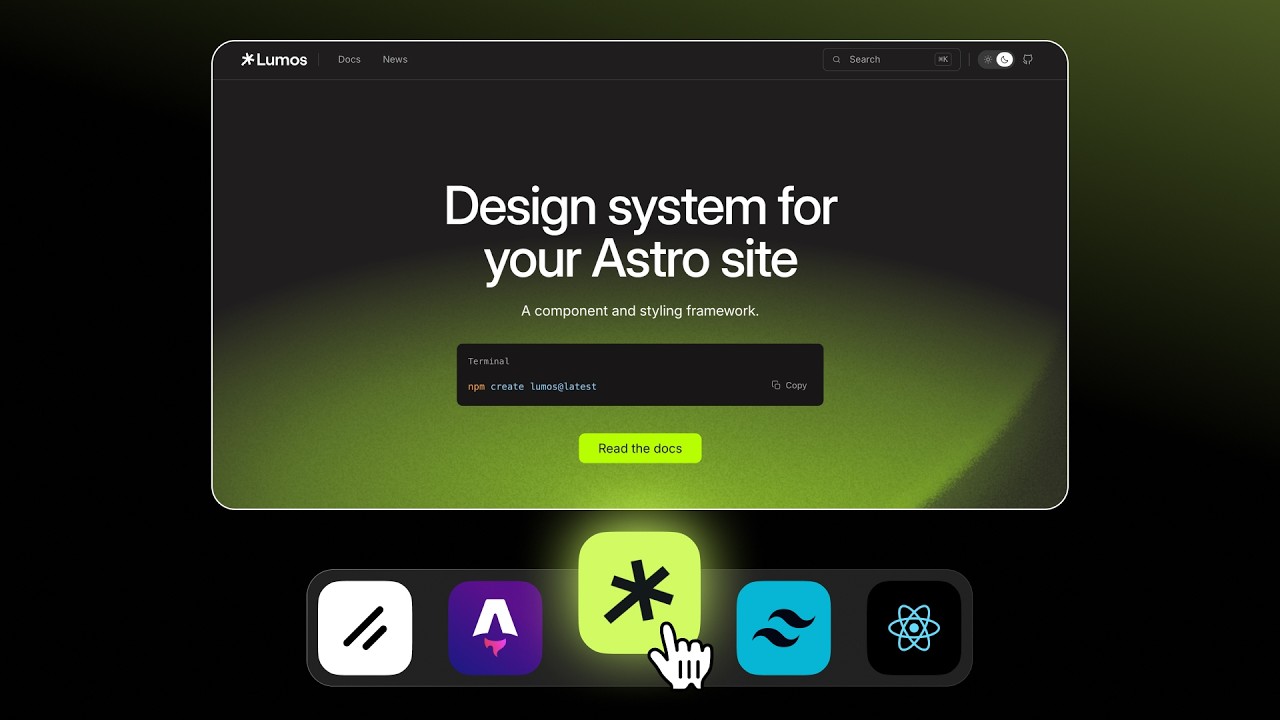
This video introduces a free, ESLint-like command-line tool that performs static analysis to catch the maintainability problems AI coding agents create - dead code, duplicated blocks, oversized files, and high-complexity functions - and shows how to run it, configure ignores, expose it to agents as a skill, and wire it into CI so code is checked before it merges.
Web Dev SimplifiedWatchTranscript found
Quick learning frame
Read this before watching.
A model becomes useful when it is wrapped in a harness: tools, state, permissions, memory, routing, and verification.
New playlist item from Web Dev Simplified; queued for transcript-backed review, topic mapping, and a practical learning artifact.
Skill you build: The ability to run static-analysis maintainability checks (dead code, duplication, complexity/CRAP scores) on a codebase and feed them back into an agentic workflow so the AI reviews and fixes its own output before it reaches your main branch.
Watch for the shift from claim to mechanism. The learning value is the point where the transcript reveals a repeatable action, tool boundary, context move, review habit, or artifact.
Concept diagram
Where this video fits.
01User intent
02Model role
03Tool surface
04State and memory
05Verification loop
06Reusable operating rule
Deep lesson
Turn this video into working knowledge.
5,054 cleaned transcript words reviewed across 1,382 timed caption segments.
Thesis
I Won’t Use AI Without This Tool teaches a practical agent harness move: This video introduces a free, ESLint-like command-line tool that performs static analysis to catch the maintainability problems AI coding agents create - dead code, duplicated blocks, oversized files, and high-complexity functions - and shows how to run it, configure ignores, expose it to agents as a skill, and wire it into CI so code is checked before it merges.
The goal is not to remember the video. The goal is to extract the operating principle, tie it to timestamped evidence, test how far the claim transfers, and make something reusable.
1:00
Why AI code rots
“problems and is really built to solve the problems that AI coding has. But it's not just useful on AI projects. I'm going to show you how to use this on both an entirely handcoded project and an...”
AI agents reliably produce unmaintainable code: identical blocks duplicated across a file, files hundreds of lines long with hard-to-parse functions, and dead code left behind after refactors plus exports that are never imported anywhere - and AI is itself bad at finding and fixing these, which is the gap this tool fills. Open a recent AI-generated file and manually hunt for one duplicated block and one unused export, so you internalize the exact patterns the tool will later flag automatically.
10:26
Reading the report
“to install this in my project directory and I'm going to say yes, I'm okay with installing that. And now if we look in this agents folder, you can see we have this skills file and we have...”
Running the tool with npx auto-detects plugins (Vite, Next.js, TanStack, Tailwind) and outputs sections for dead code, duplication, and complexity, where complexity surfaces cyclomatic branch counts, cognitive load for readability, and a CRAP score that combines complexity with test coverage - plus file-health, hotspot (from git churn), and prioritized refactoring-target sections. Run the tool on one project and locate your worst CRAP-score function, then check whether its high score comes from too many branches, low test coverage, or both.
12:49
Wire it into the agent
“into your main branch. Now, the next thing I want to show you is how you actually use to be able to configure it properly. For example, this project is a fully handwritten project and there's a lot...”
Install the tool as a skill via npx skills add so any skill-supporting agent can invoke it, then have the agent implement a feature and run the tool (using the JSON output that lists actions and fixes) to self-review and autocorrect; the same command drops into CI to block non-compliant code before it merges. Install the skill in a project, then prompt your agent to implement a small feature and run the tool on its own output to fix violations, and add the CI snippet so the check runs on every pull request.
01
User intent
Start with this video's job: This video introduces a free, ESLint-like command-line tool that performs static analysis to catch the maintainability problems AI coding agents create - dead code, duplicated blocks, oversized files, and high-complexity functions - and shows how to run it, configure ignores, expose it to agents as a skill, and wire it into CI so code is checked before it merges. Treat "User intent" as the outcome you are trying to make visible, not a topic label. Anchor it to 1:00, where the video says: “problems and is really built to solve the problems that AI coding has. But it's not just useful on AI projects. I'm going to show you how to use this on both an entirely handcoded project and an...”
02
Model role
Use "Model role" to locate the part of the agent harness mechanism the video is demonstrating. Ask what changes in your real setup if this claim is true. Anchor it to 10:26, where the video says: “to install this in my project directory and I'm going to say yes, I'm okay with installing that. And now if we look in this agents folder, you can see we have this skills file and we have...”
03
Tool surface
Turn "Tool surface" into the reusable artifact for this lesson: A one-page agent harness map with tool boundaries, state ownership, and proof signals. This is where watching becomes something you can inspect and reuse.
04
State and memory
Use "State and memory" as the application surface. Decide whether the idea touches a browser flow, a local file, a model choice, a source document, a UI, or a review step.
05
Verification loop
Use "Verification loop" to prove the lesson. The evidence should connect back to the video title, transcript anchors, and a concrete output, not a generic best-practice claim.
06
Reusable operating rule
Use "Reusable operating rule" to carry the idea forward: save the prompt, checklist, diagram, or operating rule that would make the next agent run better.
Example
Source-backed artifact packet
Convert the video into a scoped artifact request that includes the transcript claim, mechanism, acceptance criteria, and proof. The output should be a one-page agent harness map with tool boundaries, state ownership, and proof signals..
Example
Agent harness proof brief
Separate what the speaker claims, what the demo actually proves, and what still needs outside verification before you adopt the agent harness pattern.
Example
Teach-back module
Transform the lesson into a definition, a User intent -> Model role -> Tool surface -> State and memory -> Verification loop -> Reusable operating rule diagram, one misconception, one practice exercise, and a check-for-understanding question.
Do not learn it wrong
Treating the title as the lesson without checking what the transcript actually says.
treating model choice as architecture
ignoring tool permissions
missing verification evidence
Letting the lesson drift into generic agent definitions.
Letting the lesson drift into model leaderboard claims.
Letting the lesson drift into tool list without operating boundaries.
Do not count this as learned until these are true.
01
State the transcript-backed claim in your own words: This video introduces a free, ESLint-like command-line tool that performs static analysis to catch the maintainability problems AI coding agents create - dead code, duplicated blocks, oversized files, and high-complexity functions - and shows how to run it, configure ignores, expose it to agents as a skill, and wire it into CI so code is checked before it merges.
02
Explain the practical stakes without hype: New playlist item from Web Dev Simplified; queued for transcript-backed review, topic mapping, and a practical learning artifact.
03
Map the idea onto the User intent -> Model role -> Tool surface -> State and memory -> Verification loop -> Reusable operating rule sequence and name the weakest link.
04
Produce the artifact and include the evidence that proves it: A one-page agent harness map with tool boundaries, state ownership, and proof signals.
Put it into practice
Give this grounded prompt to Codex or Claude after watching.
You are helping me turn one specific YouTube video into real, durable learning.

Source video:
- Title: I Won’t Use AI Without This Tool
- URL: https://www.youtube.com/watch?v=t3my5ByUhFU
- Topic: Agent Architecture
- My current learning frame: Run this static-analysis tool on one of your AI-generated projects, fix its top refactoring target (dead code or a high-complexity function), add an ignore config for legitimate duplication like test files, then install it as an agent skill so future AI changes get self-reviewed before they merge.
- Why this matters: New playlist item from Web Dev Simplified; queued for transcript-backed review, topic mapping, and a practical learning artifact.

Transcript anchors from this exact video:
- 1:00 / Evidence 1: "problems and is really built to solve the problems that AI coding has. But it's not just useful on AI projects. I'm going to show you how to use this on both an entirely handcoded project and an..."
- 3:39 / Evidence 2: "dependencies, you can see that they show up inside this list. And some dependencies you may only be using for testing. So you can use those and move them out of your production environment. So this is just..."
- 5:18 / Evidence 3: "function. That is massive. Next we have the cognitive load that has a value of 133. And this is like how difficult is the code to read. For example, if you have nested if statements or nested loops,..."
- 7:54 / Evidence 4: "my buck. And it kind of rates these just like this. Now, finally, at the bottom, I kind of get an overall score. And the nice thing is is if I want to be able to just compare,..."
- 10:26 / Evidence 5: "to install this in my project directory and I'm going to say yes, I'm okay with installing that. And now if we look in this agents folder, you can see we have this skills file and we have..."
- 12:49 / Evidence 6: "into your main branch. Now, the next thing I want to show you is how you actually use to be able to configure it properly. For example, this project is a fully handwritten project and there's a lot..."
- 16:09 / Evidence 7: "actually change to semantic mode. And the semantic mode is not only going to check for duplicates where all the variables are the same name, but also, let's say, for example, you rename a variable to something else..."

Video-aware target:
- Prompt lane: Agent harness
- Mechanism to extract: Identify what surrounding harness makes the model more useful than chat alone.
- Artifact to produce: A one-page agent harness map with tool boundaries, state ownership, and proof signals.
- Artifact must include: model role; tools; state/memory; permission boundary; verification proof

Your task:
1. Use the transcript anchors above as the primary source packet. If you add outside context, label it clearly as outside context and keep it secondary.
2. Create a source-check table with columns: timestamp, claim, transcript support, what the demo proves, confidence, and what still needs verification.
3. Extract the actual teachable mechanism from the video: Identify what surrounding harness makes the model more useful than chat alone. Do not invent claims that are not supported by the title, lesson frame, or transcript anchors.
4. Build a reusable learning artifact: A one-page agent harness map with tool boundaries, state ownership, and proof signals.
5. Include:
   - a plain-English definition of the core idea
   - a diagram or structured model using this sequence: User intent -> Model role -> Tool surface -> State and memory -> Verification loop -> Reusable operating rule
   - answers to these source questions: What does the video claim the agent can do? | What surrounding system makes that claim plausible? | What proof is shown instead of merely asserted?
   - 3 concrete examples that apply the video idea to real agentic work, such as a repo-editing harness; a local research assistant; a recurring refresh agent
   - 2 failure modes the video helps prevent, chosen from the transcript evidence and these likely risks: treating model choice as architecture; ignoring tool permissions; missing verification evidence
   - a checklist for the next real workflow, focused on: tool boundaries, state ownership, done signal, recovery path
   - one practical exercise with a clear done signal: Map one current coding workflow as a harness and mark the first missing proof signal.
6. Add a "learning transfer" section: what changes in my workflow tomorrow if I actually learned this?
7. Add a "source check" section that cites which transcript anchor supports each major takeaway.

Quality bar:
- Make this specific to "I Won’t Use AI Without This Tool", not a generic Agent Architecture essay.
- Tie each harness element to a transcript anchor that names a tool, state boundary, permission, model behavior, or verification step.
- Prefer operational examples, failure modes, and reusable artifacts over broad definitions.
- Call out uncertainty instead of smoothing over weak evidence.
- Avoid these generic drifts: generic agent definitions; model leaderboard claims; tool list without operating boundaries.
- If evidence is weak or missing, stop and say what transcript segment or timestamp needs review instead of guessing.
- Finish with a concise artifact I could paste into my learning app.
Misconceptions
What to stop believing.
A better model automatically makes a better agent.
The model matters, but harness design determines whether the system can act safely and repeatably.
More tools always help.
Every tool increases surface area. Strong agents have the right tools with clear permissions.
Memory means saving everything.
Useful memory is compressed, curated, and tied to future decisions.
Practice studio
Learning only counts when you make something.
01
Transcript evidence map
Separate what the video actually says from what you already believe about the topic.
3 source-backed takeaways with timestamps, confidence, and a transfer note.02
One useful artifact
Apply the video to a real workflow and produce a one-page agent harness map with tool boundaries, state ownership, and proof signals..
A reusable artifact with a done signal and one verification step.03
Agent harness teach-back card
Explain the agent harness mechanism to someone who has not watched the video yet.
A 90-second explanation, one diagram, one example, and one misconception to avoid.
Recall check
Answer first, then reveal — without rewatching.
What is the video asking you to understand?
What makes this lesson trustworthy?
What should you make after watching?
Source shelf
Use the video as a doorway, then verify with primary sources.