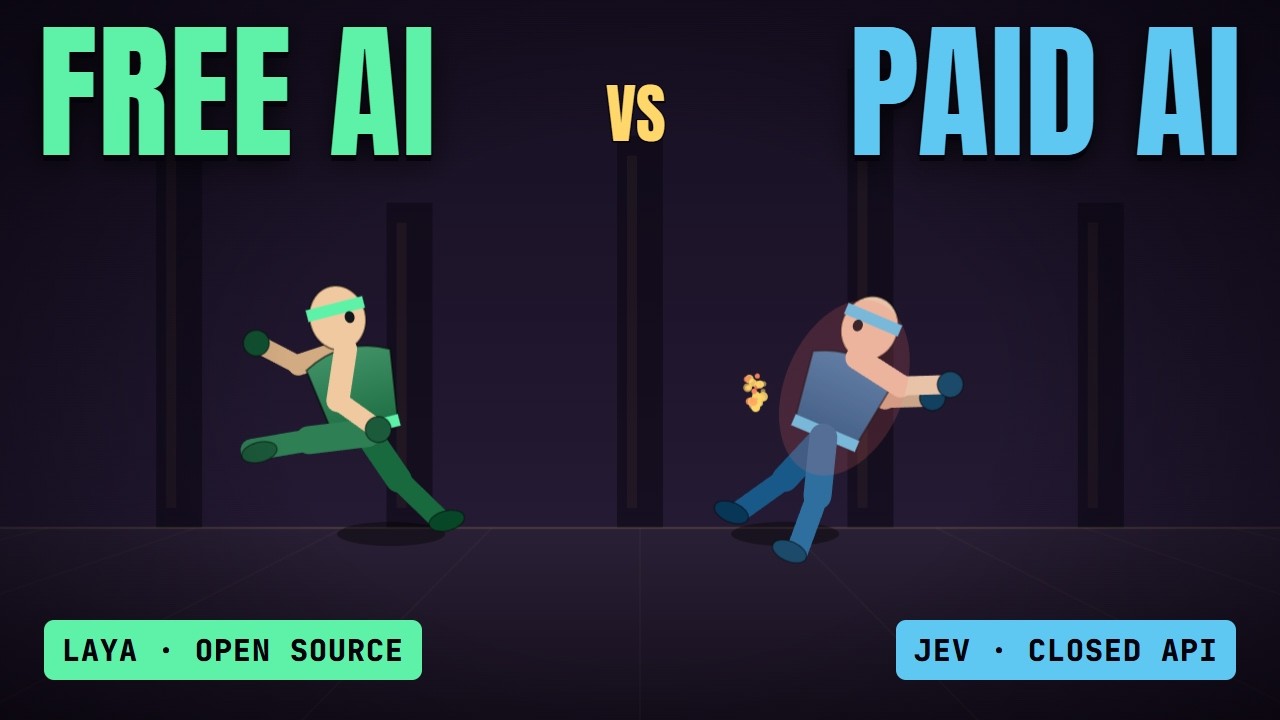
This video presents Jev as programmable intelligent question answering through JSON, progressing from yes/no decisions and multi-choice classification to scoring, agent routing, tool gates, repository-scale filtering, and agent-directed use. The central engineering lesson is to reserve expensive general agents for work that needs them and use fast specialized classification for repeated decisions at scale.
IndyDevDanWatchTranscript found
Quick learning frame
Read this before watching.
Agentic engineering turns fuzzy intent into scoped, verifiable agent work packets with standards, review, and reuse built in.
New playlist item from IndyDevDan; queued for transcript-backed review, topic mapping, and a practical learning artifact.
Skill you build: The ability to encode production decision criteria as structured Jev calls and place them at the right control points inside an agent harness.
Watch for the shift from claim to mechanism. The learning value is the point where the transcript reveals a repeatable action, tool boundary, context move, review habit, or artifact.
Concept diagram
Where this video fits.
01Intent
02Task packet
03Context
04Agent run
05Evidence
06Review
07Reusable standard
Deep lesson
Turn this video into working knowledge.
7,673 cleaned transcript words reviewed across 2,148 timed caption segments.
Thesis
10 Levels of Jev For Agentic Engineers teaches a practical agentic engineering move: This video presents Jev as programmable intelligent question answering through JSON, progressing from yes/no decisions and multi-choice classification to scoring, agent routing, tool gates, repository-scale filtering, and agent-directed use. The central engineering lesson is to reserve expensive general agents for work that needs them and use fast specialized classification for repeated decisions at scale.
The goal is not to remember the video. The goal is to extract the operating principle, tie it to timestamped evidence, test how far the claim transfers, and make something reusable.
0:37
Encode Cheap Decisions
“ways you can use Jeb for a Gentic engineering work. You'll understand why and which agent calls you should replace with Jeb ASAP. And you'll have a code base and skill you can hand your agents to get...”
Jev turns natural-language criteria and JSON options into booleans, choices, confidence levels, or scores for jobs such as prompt-injection detection and support triage. Confidence is not absolute truth, so engineers must choose thresholds and weighting rules appropriate to their own production consequences. Define a five-example support-triage set, encode category and priority choices in JSON, and write the confidence threshold that would trigger human review.
12:47
Gate and Route
“previous step to that. Okay. So, choose the least costly model that can complete the task. Let's scale it up. Choose the right agent that can handle the task at hand. Agent with a different set of tools,...”
A cheap Jev decision can route a request to the least costly capable model or specialized agent, and it can sit inside an agent's tool path to classify every Bash command before execution. In the demonstration, the Jev guard blocks an irreversible `rm -rf sessions` action while allowing read-only or reversible commands such as listing files or removing `node_modules`. Design a Bash gate with read-only, reversible, and irreversible outcomes, then specify what the harness should allow, log, or block for each result.
27:31
Let Agents Delegate
“I said it years ago, one prompt is not enough. You know, last year I started saying one agent is not enough. Then we had sub agents. Then we had multi- agent orchestration. Now we're doing agent swarms.”
At repository scale, an Ask Jev tool can classify many files in parallel, narrow a search to relevant files, and preserve the expensive model's tokens for interpretation and edits. The highest level lets the agent itself decide what questions and context to send to Jev, creating a stack that combines deterministic code, specialized classifiers, and full agents. Give an agent an Ask Jev tool that accepts file globs and a question, then test whether it can shortlist files for one known bug before the main model reads them deeply.
01
Intent
Start with this video's job: This video presents Jev as programmable intelligent question answering through JSON, progressing from yes/no decisions and multi-choice classification to scoring, agent routing, tool gates, repository-scale filtering, and agent-directed use. The central engineering lesson is to reserve expensive general agents for work that needs them and use fast specialized classification for repeated decisions at scale. Treat "Intent" as the outcome you are trying to make visible, not a topic label. Anchor it to 0:37, where the video says: “ways you can use Jeb for a Gentic engineering work. You'll understand why and which agent calls you should replace with Jeb ASAP. And you'll have a code base and skill you can hand your agents to get...”
02
Task packet
Use "Task packet" to locate the part of the agentic engineering mechanism the video is demonstrating. Ask what changes in your real setup if this claim is true. Anchor it to 12:47, where the video says: “previous step to that. Okay. So, choose the least costly model that can complete the task. Let's scale it up. Choose the right agent that can handle the task at hand. Agent with a different set of tools,...”
03
Context
Turn "Context" into the reusable artifact for this lesson: A task packet and review rubric that a coding agent could execute without wandering. This is where watching becomes something you can inspect and reuse.
04
Agent run
Use "Agent run" as the application surface. Decide whether the idea touches a browser flow, a local file, a model choice, a source document, a UI, or a review step.
05
Evidence
Use "Evidence" to prove the lesson. The evidence should connect back to the video title, transcript anchors, and a concrete output, not a generic best-practice claim.
06
Review
Use "Review" to carry the idea forward: save the prompt, checklist, diagram, or operating rule that would make the next agent run better.
07
Reusable standard
Connect "Reusable standard" to 10 Levels of Jev For Agentic Engineers by naming the claim, the evidence, and the artifact it should produce.
Example
Source-backed artifact packet
Convert the video into a scoped artifact request that includes the transcript claim, mechanism, acceptance criteria, and proof. The output should be a task packet and review rubric that a coding agent could execute without wandering..
Example
Agentic engineering proof brief
Separate what the speaker claims, what the demo actually proves, and what still needs outside verification before you adopt the agentic engineering pattern.
Example
Teach-back module
Transform the lesson into a definition, a Intent -> Task packet -> Context -> Agent run -> Evidence -> Review -> Reusable standard diagram, one misconception, one practice exercise, and a check-for-understanding question.
Do not learn it wrong
Treating the title as the lesson without checking what the transcript actually says.
delegating vague intent
accepting output without evidence
turning taste into loose preference instead of a rubric
Letting the lesson drift into generic productivity advice.
Letting the lesson drift into unsupported claims about autonomy.
Letting the lesson drift into summaries without implementation criteria.
Do not count this as learned until these are true.
01
State the transcript-backed claim in your own words: This video presents Jev as programmable intelligent question answering through JSON, progressing from yes/no decisions and multi-choice classification to scoring, agent routing, tool gates, repository-scale filtering, and agent-directed use. The central engineering lesson is to reserve expensive general agents for work that needs them and use fast specialized classification for repeated decisions at scale.
02
Explain the practical stakes without hype: New playlist item from IndyDevDan; queued for transcript-backed review, topic mapping, and a practical learning artifact.
03
Map the idea onto the Intent -> Task packet -> Context -> Agent run -> Evidence -> Review -> Reusable standard sequence and name the weakest link.
04
Produce the artifact and include the evidence that proves it: A task packet and review rubric that a coding agent could execute without wandering.
Put it into practice
Give this grounded prompt to Codex or Claude after watching.
You are helping me turn one specific YouTube video into real, durable learning.

Source video:
- Title: 10 Levels of Jev For Agentic Engineers
- URL: https://www.youtube.com/watch?v=_U-O5lYhJ7Q
- Topic: Agentic Engineering
- My current learning frame: Add one structured Jev classifier to an agent harness—such as a Bash safety gate or file-relevance filter—then compare its classifications, latency, and cost against the existing general-model path on a labeled test set.
- Why this matters: New playlist item from IndyDevDan; queued for transcript-backed review, topic mapping, and a practical learning artifact.

Transcript anchors from this exact video:
- 0:37 / Evidence 1: "ways you can use Jeb for a Gentic engineering work. You'll understand why and which agent calls you should replace with Jeb ASAP. And you'll have a code base and skill you can hand your agents to get..."
- 12:47 / Evidence 2: "previous step to that. Okay. So, choose the least costly model that can complete the task. Let's scale it up. Choose the right agent that can handle the task at hand. Agent with a different set of tools,..."
- 20:09 / Evidence 3: "the engineering industry is focused on making Jev play games, control UIs, and do random stupid stuff just to kind of clickbait, this model can do extraordinary things inside your current workflows that can save you tons of..."
- 23:05 / Evidence 4: "accomplish this work? Right? You can offload a whole set of work that your heavy reading file agents are performing. So this is level eight of Jev. Cheap reads, dirt cheap reads. And not just reads, it's decision-m,..."
- 25:02 / Evidence 5: "can make the change. But often times your agents are going to look at files to understand information. And to understand information you ask a question. And if you're going to do that you can use Jev. You..."
- 27:31 / Evidence 6: "I said it years ago, one prompt is not enough. You know, last year I started saying one agent is not enough. Then we had sub agents. Then we had multi- agent orchestration. Now we're doing agent swarms."
- 33:58 / Evidence 7: "with this incredible technology. You can be saving money on your language model calls right now today. And the higher you're scaled up with agents in production in your products and especially engineers building Outloop systems like their..."

Video-aware target:
- Prompt lane: Agentic engineering
- Mechanism to extract: Extract the engineering loop that converts an agent demo into controlled, inspectable work.
- Artifact to produce: A task packet and review rubric that a coding agent could execute without wandering.
- Artifact must include: scope; context inputs; acceptance criteria; verification command; review rubric

Your task:
1. Use the transcript anchors above as the primary source packet. If you add outside context, label it clearly as outside context and keep it secondary.
2. Create a source-check table with columns: timestamp, claim, transcript support, what the demo proves, confidence, and what still needs verification.
3. Extract the actual teachable mechanism from the video: Extract the engineering loop that converts an agent demo into controlled, inspectable work. Do not invent claims that are not supported by the title, lesson frame, or transcript anchors.
4. Build a reusable learning artifact: A task packet and review rubric that a coding agent could execute without wandering.
5. Include:
   - a plain-English definition of the core idea
   - a diagram or structured model using this sequence: Intent -> Task packet -> Context -> Agent run -> Evidence -> Review -> Reusable standard
   - answers to these source questions: What work packet is implied? | Which context does the agent need before editing? | How does the video define proof or quality?
   - 3 concrete examples that apply the video idea to real agentic work, such as a feature patch packet; a test-fix packet; a learning-page improvement packet
   - 2 failure modes the video helps prevent, chosen from the transcript evidence and these likely risks: delegating vague intent; accepting output without evidence; turning taste into loose preference instead of a rubric
   - a checklist for the next real workflow, focused on: scope, files/context, tests, review criteria
   - one practical exercise with a clear done signal: Rewrite one vague request into a bounded agent packet with explicit proof of done.
6. Add a "learning transfer" section: what changes in my workflow tomorrow if I actually learned this?
7. Add a "source check" section that cites which transcript anchor supports each major takeaway.

Quality bar:
- Make this specific to "10 Levels of Jev For Agentic Engineers", not a generic Agentic Engineering essay.
- Cite the transcript wherever the prompt names a task boundary, review habit, context move, or verification standard.
- Prefer operational examples, failure modes, and reusable artifacts over broad definitions.
- Call out uncertainty instead of smoothing over weak evidence.
- Avoid these generic drifts: generic productivity advice; unsupported claims about autonomy; summaries without implementation criteria.
- If evidence is weak or missing, stop and say what transcript segment or timestamp needs review instead of guessing.
- Finish with a concise artifact I could paste into my learning app.
Misconceptions
What to stop believing.
Agentic engineering means letting agents do everything.
It means designing work so agents can do bounded pieces well.