Claude Code Makes Cinematic AI Ads From Any Website
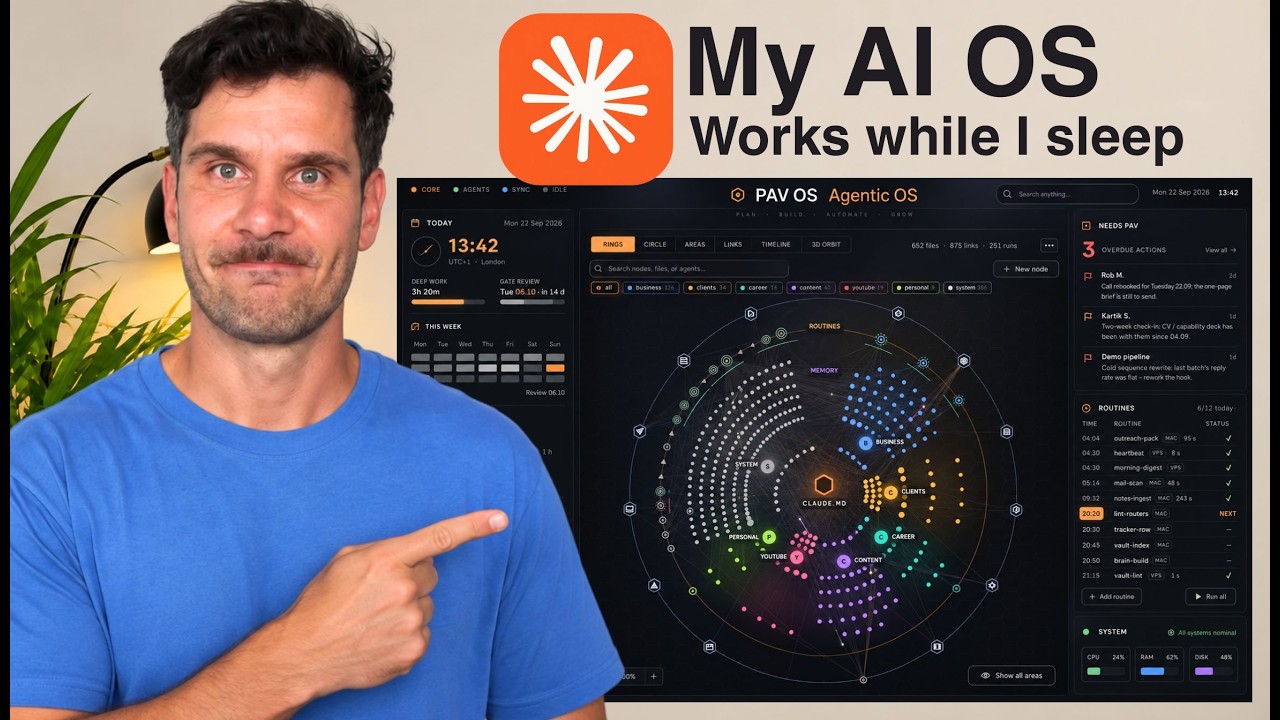
Duncan Rogoff builds, from scratch, a reusable Claude Code skill ('SAS Ad Studio') that turns any SaaS website into a cinematic UI-focused ad — assembling pieces like Higgsfield's CRM master prompt, a downloadable motion-design skill, and the Higgsfield MCP connector, then art-directing the generated storyboard before rendering a 15-second test ad for his Claude Code Club site.
Duncan Rogoff | Learn Claude Code13 minTranscript found
Quick learning frame
Read this before watching.
Coding-agent workflow is the loop of inspect, route, plan, edit, verify, summarize, and decide what should be automated next.
New playlist item from Duncan Rogoff | Learn Claude Code; queued for transcript-backed review, topic mapping, and a practical learning artifact.
Skill you build: The ability to combine found assets (a vendor master prompt, an existing skill, an MCP connector) into a custom reusable Claude Code skill, and to act as art director on its output — critiquing storyboards and feeding revisions back so the skill improves each run.
Watch for the shift from claim to mechanism. The learning value is the point where the transcript reveals a repeatable action, tool boundary, context move, review habit, or artifact.
Concept diagram
Where this video fits.
01Inspect context
02Route tool
03Plan work
04Edit safely
05Verify behavior
06Report next step
Deep lesson
Turn this video into working knowledge.
3,176 cleaned transcript words reviewed across 845 timed caption segments.
Thesis
Claude Code Makes Cinematic AI Ads From Any Website teaches a practical coding-agent workflow move: Duncan Rogoff builds, from scratch, a reusable Claude Code skill ('SAS Ad Studio') that turns any SaaS website into a cinematic UI-focused ad — assembling pieces like Higgsfield's CRM master prompt, a downloadable motion-design skill, and the Higgsfield MCP connector, then art-directing the generated storyboard before rendering a 15-second test ad for his Claude Code Club site.
The goal is not to remember the video. The goal is to extract the operating principle, tie it to timestamped evidence, test how far the claim transfers, and make something reusable.
0:51
Ads for intangible products
“going to take my website for the Claude Code Club, which is my community where I teach people how to build cool things with Claude Code and earn income. And hopefully, some of the skills you learned today,...”
The video answers the common objection that cinematic AI ads only work for physical products: for a SaaS company or website, the pipeline instead extracts info and screenshots from the site, builds a storyboard, and stitches everything into a final video featuring the real UI. Duncan deliberately builds from scratch on camera — showing how he collects puzzle pieces like Higgsfield's brief, its CRM sample use case with a 60-second product-launch video, and the master prompt buried at the bottom of that PDF. Pick one SaaS site you use and write down the three raw ingredients you would collect before prompting: the site URL, any vendor prompt or skill you can reuse, and the ad format you are copying.
3:59
Assemble pieces into a skill
“it. No, you're most likely not going to break it. All you need to do is tell Claude Code what you are trying to accomplish and then have it back and forth from there. You can think of...”
He drops the downloaded motion-design skill and the CRM PDF into a fresh folder, then tells Claude Code the goal — a repeatable skill for cinematic SaaS ads via the Higgsfield MCP — and lets it read the assets, cut the irrelevant UGC parts, and propose a pipeline: extract brand DNA from the URL, generate a concept with a strong hook, build a shot list and hero frames, animate, add music, and assemble. Connecting Higgsfield is just pasting its MCP URL as a custom connector, and he revises one plan detail (swapping Nano Banana Pro for the GPT image model because it preserves text better) before building. Connect one MCP server to Claude Code as a custom connector, then write a skill-creation prompt that names your goal, lists the reference files in the folder, and explicitly says which parts of them to keep or cut.
9:23
You are the art director
“concept which is the core promise which is this idea that you can go from not knowing anything to building with claude and getting paid something that's proof first like lead with receipts like anything that our members...”
When the first 15-second storyboard over-indexes on three screenshots in a row with hard cuts, Duncan pushes back with specific direction — roughly eight fast-paced shots, a laptop-in-scene shot, an abstract community visual, member proof points like '$400 first client paid,' and deliberate transitions — and the revision is markedly better. Crucially, feedback given at this stage also improves the skill itself, so every future run starts from a higher baseline. Take any AI-generated storyboard or shot list and write a three-point art-direction critique covering shot count and pacing, visual variety, and transitions before approving a render.
01
Inspect context
Start with this video's job: Duncan Rogoff builds, from scratch, a reusable Claude Code skill ('SAS Ad Studio') that turns any SaaS website into a cinematic UI-focused ad — assembling pieces like Higgsfield's CRM master prompt, a downloadable motion-design skill, and the Higgsfield MCP connector, then art-directing the generated storyboard before rendering a 15-second test ad for his Claude Code Club site. Treat "Inspect context" as the outcome you are trying to make visible, not a topic label. Anchor it to 0:51, where the video says: “going to take my website for the Claude Code Club, which is my community where I teach people how to build cool things with Claude Code and earn income. And hopefully, some of the skills you learned today,...”
02
Route tool
Use "Route tool" to locate the part of the coding-agent workflow mechanism the video is demonstrating. Ask what changes in your real setup if this claim is true. Anchor it to 3:59, where the video says: “it. No, you're most likely not going to break it. All you need to do is tell Claude Code what you are trying to accomplish and then have it back and forth from there. You can think of...”
03
Plan work
Turn "Plan work" into the reusable artifact for this lesson: A coding-agent routing and execution matrix with context needed, tool choice, verification, and done signal. This is where watching becomes something you can inspect and reuse.
04
Edit safely
Use "Edit safely" as the application surface. Decide whether the idea touches a browser flow, a local file, a model choice, a source document, a UI, or a review step.
05
Verify behavior
Use "Verify behavior" to prove the lesson. The evidence should connect back to the video title, transcript anchors, and a concrete output, not a generic best-practice claim.
06
Report next step
Use "Report next step" to carry the idea forward: save the prompt, checklist, diagram, or operating rule that would make the next agent run better.
Example
Source-backed artifact packet
Convert the video into a scoped artifact request that includes the transcript claim, mechanism, acceptance criteria, and proof. The output should be a coding-agent routing and execution matrix with context needed, tool choice, verification, and done signal..
Example
Coding-agent workflow proof brief
Separate what the speaker claims, what the demo actually proves, and what still needs outside verification before you adopt the coding-agent workflow pattern.
Example
Teach-back module
Transform the lesson into a definition, a Inspect context -> Route tool -> Plan work -> Edit safely -> Verify behavior -> Report next step diagram, one misconception, one practice exercise, and a check-for-understanding question.
Do not learn it wrong
Treating the title as the lesson without checking what the transcript actually says.
choosing tools by hype
losing context across agents
letting parallel sessions become invisible
Letting the lesson drift into generic Codex vs Claude comparison.
Letting the lesson drift into feature lists without task routing.
Letting the lesson drift into claims that ignore limits or recovery.
Do not count this as learned until these are true.
01
State the transcript-backed claim in your own words: Duncan Rogoff builds, from scratch, a reusable Claude Code skill ('SAS Ad Studio') that turns any SaaS website into a cinematic UI-focused ad — assembling pieces like Higgsfield's CRM master prompt, a downloadable motion-design skill, and the Higgsfield MCP connector, then art-directing the generated storyboard before rendering a 15-second test ad for his Claude Code Club site.
02
Explain the practical stakes without hype: New playlist item from Duncan Rogoff | Learn Claude Code; queued for transcript-backed review, topic mapping, and a practical learning artifact.
03
Map the idea onto the Inspect context -> Route tool -> Plan work -> Edit safely -> Verify behavior -> Report next step sequence and name the weakest link.
04
Produce the artifact and include the evidence that proves it: A coding-agent routing and execution matrix with context needed, tool choice, verification, and done signal.
Put it into practice
Give this grounded prompt to Codex or Claude after watching.
You are helping me turn one specific YouTube video into real, durable learning.

Source video:
- Title: Claude Code Makes Cinematic AI Ads From Any Website
- URL: https://www.youtube.com/watch?v=ZwgUSt72hw0
- Topic: Creative Automation
- My current learning frame: Build your own website-to-ad skill: gather a vendor prompt or existing motion skill, connect an image/video MCP, have Claude Code package them into a reusable pipeline, then run it on a real site and do one written art-direction revision pass before rendering a short test ad.
- Why this matters: New playlist item from Duncan Rogoff | Learn Claude Code; queued for transcript-backed review, topic mapping, and a practical learning artifact.

Transcript anchors from this exact video:
- 0:51 / Evidence 1: "going to take my website for the Claude Code Club, which is my community where I teach people how to build cool things with Claude Code and earn income. And hopefully, some of the skills you learned today,..."
- 2:28 / Evidence 2: "master prompt for recreating all of these assets, but for a different product. So, like for a different website. So, I'm just going to make note of this down here in red, and I'm just going to say..."
- 3:59 / Evidence 3: "it. No, you're most likely not going to break it. All you need to do is tell Claude Code what you are trying to accomplish and then have it back and forth from there. You can think of..."
- 5:56 / Evidence 4: "like that, in about two seconds, you'll be connected and ready to go. This MCP will give you access to every single thing you can do inside of Higsfield. You can generate all your images, video, and audio..."
- 7:27 / Evidence 5: "Nano Banana Pro. I might actually instruct this to use GPT2. Can I actually leave a comment here? Uh, use GPT2 image model instead because I think that one does a better job of preserving text, which is..."
- 9:23 / Evidence 6: "concept which is the core promise which is this idea that you can go from not knowing anything to building with claude and getting paid something that's proof first like lead with receipts like anything that our members..."
- 11:15 / Evidence 7: "we want to show something abstract. And I'm not sure what that is. So, let's just talk with Claude Code to refine the storyboard one more time before we go into production on the actual video. So, I'm..."

Video-aware target:
- Prompt lane: Coding-agent workflow
- Mechanism to extract: Find the workflow rule that explains when and how to use Codex, Claude Code, browser control, dashboards, or manual review.
- Artifact to produce: A coding-agent routing and execution matrix with context needed, tool choice, verification, and done signal.
- Artifact must include: task class; agent/tool choice; context packet; verification step; handoff/recovery rule

Your task:
1. Use the transcript anchors above as the primary source packet. If you add outside context, label it clearly as outside context and keep it secondary.
2. Create a source-check table with columns: timestamp, claim, transcript support, what the demo proves, confidence, and what still needs verification.
3. Extract the actual teachable mechanism from the video: Find the workflow rule that explains when and how to use Codex, Claude Code, browser control, dashboards, or manual review. Do not invent claims that are not supported by the title, lesson frame, or transcript anchors.
4. Build a reusable learning artifact: A coding-agent routing and execution matrix with context needed, tool choice, verification, and done signal.
5. Include:
   - a plain-English definition of the core idea
   - a diagram or structured model using this sequence: Inspect context -> Route tool -> Plan work -> Edit safely -> Verify behavior -> Report next step
   - answers to these source questions: What workflow pain is being solved? | What exact coordination mechanism is shown? | What evidence proves it changes the work?
   - 3 concrete examples that apply the video idea to real agentic work, such as rate-limit routing; browser verification after a UI edit; long-running /goal session review
   - 2 failure modes the video helps prevent, chosen from the transcript evidence and these likely risks: choosing tools by hype; losing context across agents; letting parallel sessions become invisible
   - a checklist for the next real workflow, focused on: routing decision, context portability, verification, handoff summary
   - one practical exercise with a clear done signal: Route three recent tasks across Codex, Claude, browser checks, and manual review with a reason for each.
6. Add a "learning transfer" section: what changes in my workflow tomorrow if I actually learned this?
7. Add a "source check" section that cites which transcript anchor supports each major takeaway.

Quality bar:
- Make this specific to "Claude Code Makes Cinematic AI Ads From Any Website", not a generic Creative Automation essay.
- Each workflow rule must point to a timestamped claim or demo moment, then state what remains unproven.
- Prefer operational examples, failure modes, and reusable artifacts over broad definitions.
- Call out uncertainty instead of smoothing over weak evidence.
- Avoid these generic drifts: generic Codex vs Claude comparison; feature lists without task routing; claims that ignore limits or recovery.
- If evidence is weak or missing, stop and say what transcript segment or timestamp needs review instead of guessing.
- Finish with a concise artifact I could paste into my learning app.
Misconceptions
What to stop believing.
Creative AI removes the need for taste.
It increases the need for taste because output volume explodes.
The best prompt is enough.
References, critique, iteration, and post-production matter just as much.
Practice studio
Learning only counts when you make something.
01
Transcript evidence map
Separate what the video actually says from what you already believe about the topic.
3 source-backed takeaways with timestamps, confidence, and a transfer note.02
One useful artifact
Apply the video to a real workflow and produce a coding-agent routing and execution matrix with context needed, tool choice, verification, and done signal..
A reusable artifact with a done signal and one verification step.03
Coding-agent workflow teach-back card
Explain the coding-agent workflow mechanism to someone who has not watched the video yet.
A 90-second explanation, one diagram, one example, and one misconception to avoid.
Recall check
Answer first, then reveal — without rewatching.
How does the pipeline adapt cinematic ad creation for a SaaS product that has no physical form?
What raw materials did Duncan give Claude Code to build the SAS Ad Studio skill, and how was Higgsfield connected?
What specific critiques did Duncan give on the first storyboard, and why does giving that feedback matter beyond this one video?
Source shelf
Use the video as a doorway, then verify with primary sources.