271 Vulnerabilities: What Mozilla's AI Found Changes Everything
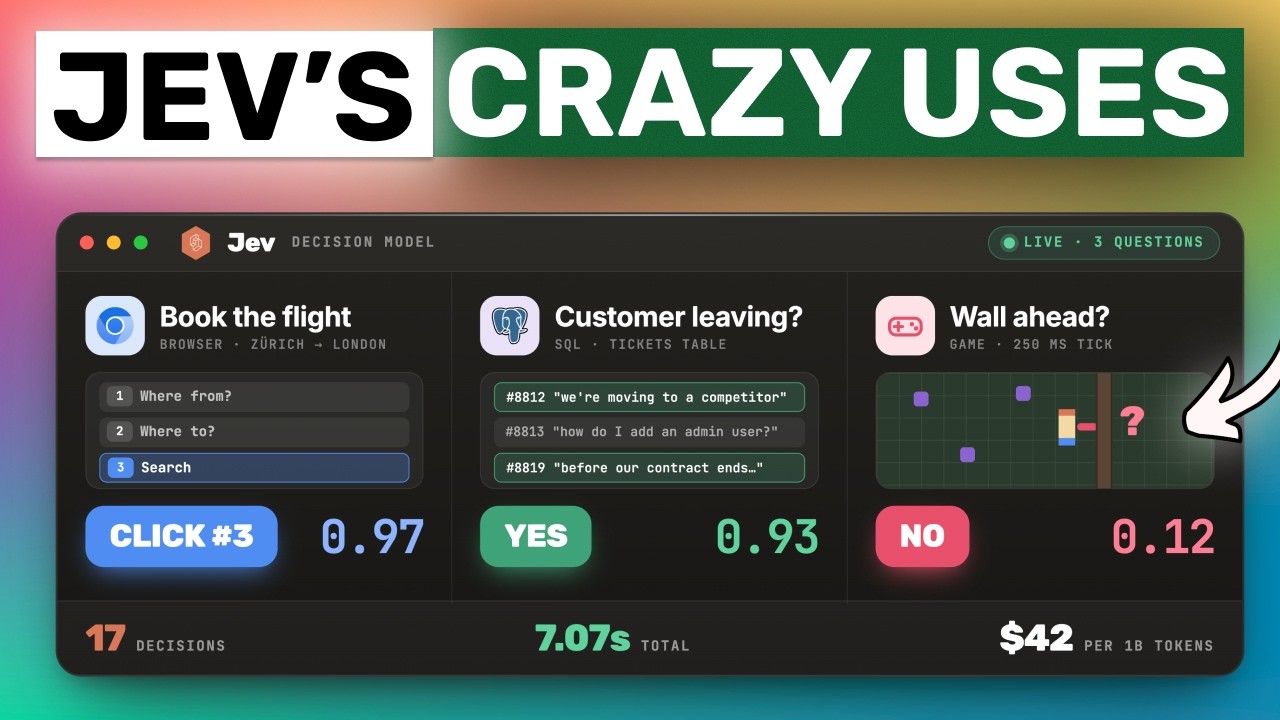
Nate B Jones unpacks Mozilla's 'Mythos' experiment — where Anthropic's Claude Mythos preview surfaced 271 vulnerabilities fixed in Firefox 150 — to argue the trust anchor is flipping from human-authored code to code that has survived adversarial machine-scale review, and what that means for how engineers architect pipelines.
AI News & Strategy Daily | Nate B Jones31 minTranscript found
Quick learning frame
Read this before watching.
AI strategy chooses where agents create durable leverage, then manages scope, adoption, risk, and measurable outcomes.
New playlist item from AI News & Strategy Daily | Nate B Jones; queued for transcript-backed review, topic mapping, and a practical learning artifact.
Skill you build: The ability to redesign a software pipeline and engineering role around machine-scale adversarial code review, concentrating human judgment on defining a system's meaning and verifiable boundaries rather than on hand-reviewing every line.
Watch for the shift from claim to mechanism. The learning value is the point where the transcript reveals a repeatable action, tool boundary, context move, review habit, or artifact.
Concept diagram
Where this video fits.
01Use case
02Workflow pain
03Agent role
04Adoption path
05Risk
06Metric
07Pilot
Deep lesson
Turn this video into working knowledge.
6,094 cleaned transcript words reviewed across 1,810 timed caption segments.
Thesis
271 Vulnerabilities: What Mozilla's AI Found Changes Everything teaches a practical ai strategy move: Nate B Jones unpacks Mozilla's 'Mythos' experiment — where Anthropic's Claude Mythos preview surfaced 271 vulnerabilities fixed in Firefox 150 — to argue the trust anchor is flipping from human-authored code to code that has survived adversarial machine-scale review, and what that means for how engineers architect pipelines.
The goal is not to remember the video. The goal is to extract the operating principle, tie it to timestamped evidence, test how far the claim transfers, and make something reusable.
1:07
The trust flip
“software, human written code has been the default trust anchor, right? Humans write the code, machines maybe help check it. But if models get good enough at attacking, at testing, at repairing, at verifying code, the trust model...”
Firefox 150 shipped fixes for 271 vulnerabilities that Mythos identified in one release cycle — up from 22 security-sensitive bugs (14 high severity) found earlier by Opus 4.6 in version 148 — even though Firefox is one of the most hardened codebases with fuzzing, sandboxing, and bug bounties. This makes 'a good human engineer wrote this' a weaker security claim than it used to be. Write down the assumptions your team makes about why human-written code is trusted, then note which of those assumptions a machine that exhaustively searches code consequences would undermine.
13:42
Meaning vs implementation
“not just talking about changing source code by hand anymore. But we're not even talking about agentic pipelines where we review by hand soon. Although not everybody has mythos and I'm not saying every AI system is equivalent.”
Security failures live in the gap between what code means to the author and what it actually permits — e.g. the author meant a parser accepts one format, but two parsers can disagree and the attack lives in between. Vulnerability research is adversarial interpretation: reading code like an essay to find what it allows regardless of intent, and Mythos joins that loop by forming hypotheses, generating test cases, reproducing issues, and explaining them. Take a small function you wrote and re-read it adversarially, listing every input or behavior it technically permits that you did not intend to allow.
24:33
Comprehensibility as security
“implementation and verification that is produced by these agentic pipelines that we're going to start to need to review at scale. And this changes what a valuable developer starts to look like. Right? Because the valuable engineer is...”
Because clean architecture is what lets an AI researcher reason over code, comprehensibility becomes a security property: narrow modules, explicit boundaries, small interfaces, good tests, and clear specs all give the model something to constrain and satisfy. Technical debt becomes security debt, so there is a four-to-five month 'golden refactor window' to make code interpretable before adversarial systems become common. Pick one messy module and refactor it toward narrow modules, explicit boundaries, and clear tests so an AI reviewer could reason over it, then note which changes also made the intent clearer to humans.
01
Use case
Start with this video's job: Nate B Jones unpacks Mozilla's 'Mythos' experiment — where Anthropic's Claude Mythos preview surfaced 271 vulnerabilities fixed in Firefox 150 — to argue the trust anchor is flipping from human-authored code to code that has survived adversarial machine-scale review, and what that means for how engineers architect pipelines. Treat "Use case" as the outcome you are trying to make visible, not a topic label. Anchor it to 1:07, where the video says: “software, human written code has been the default trust anchor, right? Humans write the code, machines maybe help check it. But if models get good enough at attacking, at testing, at repairing, at verifying code, the trust model...”
02
Workflow pain
Use "Workflow pain" to locate the part of the ai strategy mechanism the video is demonstrating. Ask what changes in your real setup if this claim is true. Anchor it to 13:42, where the video says: “not just talking about changing source code by hand anymore. But we're not even talking about agentic pipelines where we review by hand soon. Although not everybody has mythos and I'm not saying every AI system is equivalent.”
03
Agent role
Turn "Agent role" into the reusable artifact for this lesson: A one-page AI workflow decision memo with use case, leverage claim, risks, metric, and pilot plan. This is where watching becomes something you can inspect and reuse.
04
Adoption path
Use "Adoption path" as the application surface. Decide whether the idea touches a browser flow, a local file, a model choice, a source document, a UI, or a review step.
05
Risk
Use "Risk" to prove the lesson. The evidence should connect back to the video title, transcript anchors, and a concrete output, not a generic best-practice claim.
06
Metric
Use "Metric" to carry the idea forward: save the prompt, checklist, diagram, or operating rule that would make the next agent run better.
07
Pilot
Connect "Pilot" to 271 Vulnerabilities: What Mozilla's AI Found Changes Everything by naming the claim, the evidence, and the artifact it should produce.
Example
Source-backed artifact packet
Convert the video into a scoped artifact request that includes the transcript claim, mechanism, acceptance criteria, and proof. The output should be a one-page ai workflow decision memo with use case, leverage claim, risks, metric, and pilot plan..
Example
AI strategy proof brief
Separate what the speaker claims, what the demo actually proves, and what still needs outside verification before you adopt the ai strategy pattern.
Example
Teach-back module
Transform the lesson into a definition, a Use case -> Workflow pain -> Agent role -> Adoption path -> Risk -> Metric -> Pilot diagram, one misconception, one practice exercise, and a check-for-understanding question.
Do not learn it wrong
Treating the title as the lesson without checking what the transcript actually says.
hype laundering
market claims without operational proof
strategy with no pilot
Letting the lesson drift into generic AI business advice.
Letting the lesson drift into unsupported market forecasts.
Letting the lesson drift into no-risk adoption plans.
Do not count this as learned until these are true.
01
State the transcript-backed claim in your own words: Nate B Jones unpacks Mozilla's 'Mythos' experiment — where Anthropic's Claude Mythos preview surfaced 271 vulnerabilities fixed in Firefox 150 — to argue the trust anchor is flipping from human-authored code to code that has survived adversarial machine-scale review, and what that means for how engineers architect pipelines.
02
Explain the practical stakes without hype: New playlist item from AI News & Strategy Daily | Nate B Jones; queued for transcript-backed review, topic mapping, and a practical learning artifact.
03
Map the idea onto the Use case -> Workflow pain -> Agent role -> Adoption path -> Risk -> Metric -> Pilot sequence and name the weakest link.
04
Produce the artifact and include the evidence that proves it: A one-page AI workflow decision memo with use case, leverage claim, risks, metric, and pilot plan.
Put it into practice
Give this grounded prompt to Codex or Claude after watching.
You are helping me turn one specific YouTube video into real, durable learning.

Source video:
- Title: 271 Vulnerabilities: What Mozilla's AI Found Changes Everything
- URL: https://www.youtube.com/watch?v=W79FW7iUkro
- Topic: Creative Automation
- My current learning frame: Map your current build pipeline and identify where the human principal-engineer review sits, then redesign it as a modular slot you could swap for a Mythos-equivalent reviewer while a human signs off only on the software's meaning and intent.
- Why this matters: New playlist item from AI News & Strategy Daily | Nate B Jones; queued for transcript-backed review, topic mapping, and a practical learning artifact.

Transcript anchors from this exact video:
- 1:07 / Evidence 1: "software, human written code has been the default trust anchor, right? Humans write the code, machines maybe help check it. But if models get good enough at attacking, at testing, at repairing, at verifying code, the trust model..."
- 3:21 / Evidence 2: "looks plausible while quietly misunderstanding the point of your system. A good human engineer is still vastly better than a model at understanding product intent, organizational context, user promises, maintenance costs, and all of the weird unstated constraints..."
- 7:12 / Evidence 3: "for human review. DARPA's AI Cyber Challenge tested autonomous systems that find and patch vulnerabilities across big code bases. These details here differ, but the shape of what's going on with autonomous systems is very consistent, and we..."
- 9:43 / Evidence 4: "believe in agentic coding and we're setting up our agentic pipelines, we still talk about the importance of humans reviewing the code to make sure it's safe. But what Mythos may be teaching us is that even those..."
- 13:42 / Evidence 5: "not just talking about changing source code by hand anymore. But we're not even talking about agentic pipelines where we review by hand soon. Although not everybody has mythos and I'm not saying every AI system is equivalent."
- 15:48 / Evidence 6: "how we think about how we build software. And we want to build our pipeline so that we expect these kinds of changes. So if you put in your pipeline, it's modular for agentic building and you have..."
- 24:33 / Evidence 7: "implementation and verification that is produced by these agentic pipelines that we're going to start to need to review at scale. And this changes what a valuable developer starts to look like. Right? Because the valuable engineer is..."

Video-aware target:
- Prompt lane: AI strategy
- Mechanism to extract: Separate strategic signal from launch noise by identifying the workflow change and the evidence needed to trust it.
- Artifact to produce: A one-page AI workflow decision memo with use case, leverage claim, risks, metric, and pilot plan.
- Artifact must include: use case; workflow change; risk; metric; pilot scope

Your task:
1. Use the transcript anchors above as the primary source packet. If you add outside context, label it clearly as outside context and keep it secondary.
2. Create a source-check table with columns: timestamp, claim, transcript support, what the demo proves, confidence, and what still needs verification.
3. Extract the actual teachable mechanism from the video: Separate strategic signal from launch noise by identifying the workflow change and the evidence needed to trust it. Do not invent claims that are not supported by the title, lesson frame, or transcript anchors.
4. Build a reusable learning artifact: A one-page AI workflow decision memo with use case, leverage claim, risks, metric, and pilot plan.
5. Include:
   - a plain-English definition of the core idea
   - a diagram or structured model using this sequence: Use case -> Workflow pain -> Agent role -> Adoption path -> Risk -> Metric -> Pilot
   - answers to these source questions: What work changes? | Who benefits? | What evidence would make the claim decision-grade?
   - 3 concrete examples that apply the video idea to real agentic work, such as agent pilot memo; skill-library adoption plan; model-release triage note
   - 2 failure modes the video helps prevent, chosen from the transcript evidence and these likely risks: hype laundering; market claims without operational proof; strategy with no pilot
   - a checklist for the next real workflow, focused on: workflow, leverage, risk, metric, pilot
   - one practical exercise with a clear done signal: Convert one strategy claim into a two-week pilot with a measurable done signal.
6. Add a "learning transfer" section: what changes in my workflow tomorrow if I actually learned this?
7. Add a "source check" section that cites which transcript anchor supports each major takeaway.

Quality bar:
- Make this specific to "271 Vulnerabilities: What Mozilla's AI Found Changes Everything", not a generic Creative Automation essay.
- Tie each strategic claim to transcript anchors, then label any market/news context that is not proven by the video.
- Prefer operational examples, failure modes, and reusable artifacts over broad definitions.
- Call out uncertainty instead of smoothing over weak evidence.
- Avoid these generic drifts: generic AI business advice; unsupported market forecasts; no-risk adoption plans.
- If evidence is weak or missing, stop and say what transcript segment or timestamp needs review instead of guessing.
- Finish with a concise artifact I could paste into my learning app.
Misconceptions
What to stop believing.
Creative AI removes the need for taste.
It increases the need for taste because output volume explodes.
The best prompt is enough.
References, critique, iteration, and post-production matter just as much.
Practice studio
Learning only counts when you make something.
01
Transcript evidence map
Separate what the video actually says from what you already believe about the topic.
3 source-backed takeaways with timestamps, confidence, and a transfer note.02
One useful artifact
Apply the video to a real workflow and produce a one-page ai workflow decision memo with use case, leverage claim, risks, metric, and pilot plan..
A reusable artifact with a done signal and one verification step.03
AI strategy teach-back card
Explain the ai strategy mechanism to someone who has not watched the video yet.
A 90-second explanation, one diagram, one example, and one misconception to avoid.
Recall check
Answer first, then reveal — without rewatching.
How many vulnerabilities did Mythos surface in Firefox, and why is that significant given Firefox's reputation?
Where do security failures typically live, according to the meaning-versus-implementation framing?
Why does the video argue comprehensibility is becoming a security property?
Source shelf
Use the video as a doorway, then verify with primary sources.