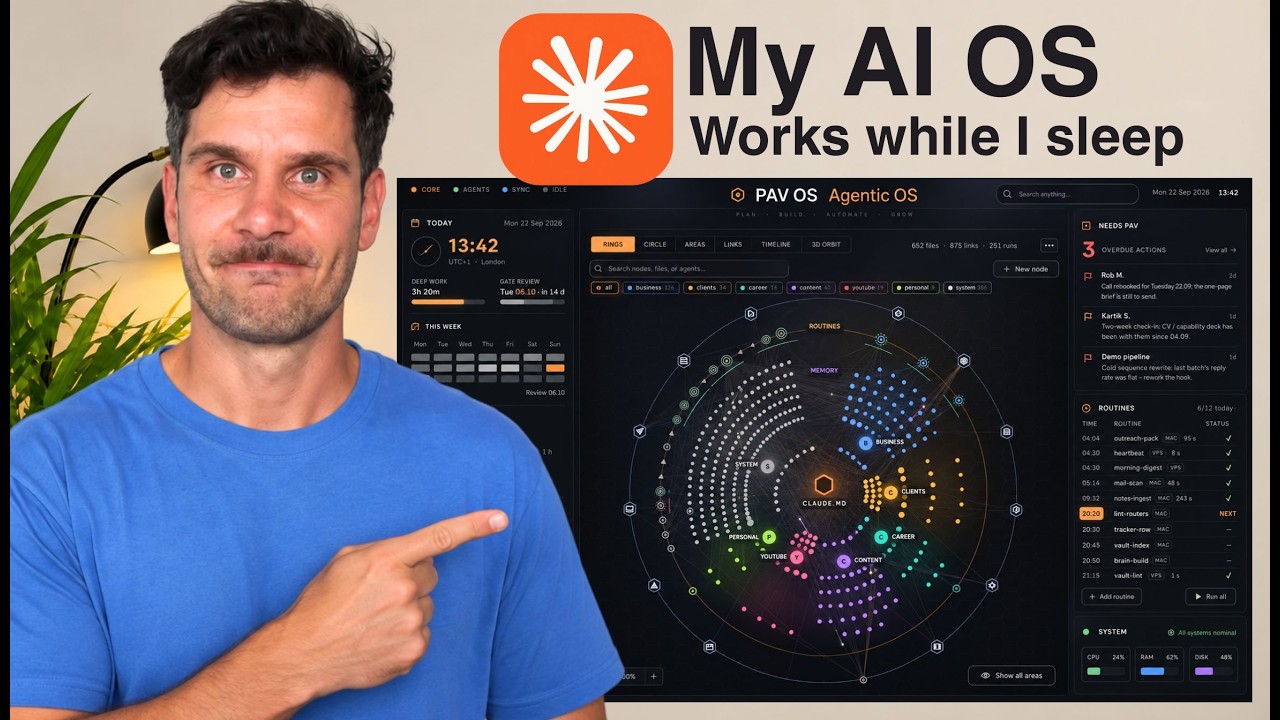
Finally, an Open Standard for the Karpathy LLM Wiki is HERE
Cole Medin explains Google's Open Knowledge Format (OKF), the standard that fixes the biggest gap in Karpathy's viral LLM wiki idea — every wiki being structured differently — by standardizing folder organization and YAML front-matter metadata so knowledge bundles can be shared between anyone's second-brain agents.
Cole Medin20 minTranscript found
Quick learning frame
Read this before watching.
A context/search lesson is about getting the right evidence into the agent at the right time through indexes, search, memory, or knowledge graphs.
New playlist item from Cole Medin; queued for transcript-backed review, topic mapping, and a practical learning artifact.
Skill you build: The ability to build or refactor a personal LLM wiki into a shareable standard format — indexes, entity pages, typed metadata, and progressive disclosure — so any OKF-aware agent can consume or produce it.
Watch for the shift from claim to mechanism. The learning value is the point where the transcript reveals a repeatable action, tool boundary, context move, review habit, or artifact.
Concept diagram
Where this video fits.
01Work question
02Source inventory
03Index/search layer
04Retrieval rule
05Agent context
06Answer/proof
07Maintenance
Deep lesson
Turn this video into working knowledge.
4,105 cleaned transcript words reviewed across 1,136 timed caption segments.
Thesis
Finally, an Open Standard for the Karpathy LLM Wiki is HERE teaches a practical context/search move: Cole Medin explains Google's Open Knowledge Format (OKF), the standard that fixes the biggest gap in Karpathy's viral LLM wiki idea — every wiki being structured differently — by standardizing folder organization and YAML front-matter metadata so knowledge bundles can be shared between anyone's second-brain agents.
The goal is not to remember the video. The goal is to extract the operating principle, tie it to timestamped evidence, test how far the claim transfers, and make something reusable.
0:28
Wikis need a standard
“easy to get started. And the idea here is when we're building a personal knowledge base for our second brain, instead of just dumping in a bunch of documents or indexing things for rag, we can have the...”
Karpathy's 40,000-star gist lets a coding agent one-shot a personal wiki that incrementally integrates new sources into interlinked entity pages, but everyone's structure diverges — different metadata fields, different linking — so agents can't optimally search someone else's wiki, blocking team wikis and shared knowledge bases. Write down the two things that vary between hand-rolled Karpathy wikis (organization and metadata fields) and one concrete sharing scenario each variation would break.
11:57
MCP for knowledge
“itself OKF. And then you go to this repo with my AI coding knowledge bundle. I'll have this linked in the description as well. And you just paste this prompt into your coding agent. That's it. You give...”
OKF is to agent-to-knowledge-base communication what MCP was to agent-to-tool communication: it standardizes both consuming (searching) and producing (evolving the wiki over time), and even solo users benefit because a shared standard lets the community trade entity-page and organization patterns that plug straight in. Take OKF's spec.md from the repo, paste it into your coding agent, and have it refactor one existing knowledge folder into the format, using subagents if the base is large.
14:47
Bundles in practice
“like the PIV loop, for example, this is the primary mental model that I always teach for AI coding. Very important to have a process for yourself to plan, implement, and validate whatever you're creating with a coding...”
Cole's AI-coding bundle shows the format working: a top-level index plus per-section indexes over videos and concepts, YAML front matter where only 'type' is required (giving categorical search) and title/tags/related fields are optional, and a small CLI so the agent lists bundles, reads an index, then drills into one concept — progressive disclosure from near-zero context to the exact answer. Clone the example bundle, ask your agent one question (like 'what is the PIV loop'), and trace which index and concept files it read to reach the answer.
01
Work question
Start with this video's job: Cole Medin explains Google's Open Knowledge Format (OKF), the standard that fixes the biggest gap in Karpathy's viral LLM wiki idea — every wiki being structured differently — by standardizing folder organization and YAML front-matter metadata so knowledge bundles can be shared between anyone's second-brain agents. Treat "Work question" as the outcome you are trying to make visible, not a topic label. Anchor it to 0:28, where the video says: “easy to get started. And the idea here is when we're building a personal knowledge base for our second brain, instead of just dumping in a bunch of documents or indexing things for rag, we can have the...”
02
Source inventory
Use "Source inventory" to locate the part of the context/search mechanism the video is demonstrating. Ask what changes in your real setup if this claim is true. Anchor it to 11:57, where the video says: “itself OKF. And then you go to this repo with my AI coding knowledge bundle. I'll have this linked in the description as well. And you just paste this prompt into your coding agent. That's it. You give...”
03
Index/search layer
Turn "Index/search layer" into the reusable artifact for this lesson: A context retrieval map with source inventory, indexing/search path, query rules, freshness checks, and agent handoff. This is where watching becomes something you can inspect and reuse.
04
Retrieval rule
Use "Retrieval rule" as the application surface. Decide whether the idea touches a browser flow, a local file, a model choice, a source document, a UI, or a review step.
05
Agent context
Use "Agent context" to prove the lesson. The evidence should connect back to the video title, transcript anchors, and a concrete output, not a generic best-practice claim.
06
Answer/proof
Use "Answer/proof" to carry the idea forward: save the prompt, checklist, diagram, or operating rule that would make the next agent run better.
07
Maintenance
Connect "Maintenance" to Finally, an Open Standard for the Karpathy LLM Wiki is HERE by naming the claim, the evidence, and the artifact it should produce.
Example
Source-backed artifact packet
Convert the video into a scoped artifact request that includes the transcript claim, mechanism, acceptance criteria, and proof. The output should be a context retrieval map with source inventory, indexing/search path, query rules, freshness checks, and agent handoff..
Example
Context/search proof brief
Separate what the speaker claims, what the demo actually proves, and what still needs outside verification before you adopt the context/search pattern.
Example
Teach-back module
Transform the lesson into a definition, a Work question -> Source inventory -> Index/search layer -> Retrieval rule -> Agent context -> Answer/proof -> Maintenance diagram, one misconception, one practice exercise, and a check-for-understanding question.
Do not learn it wrong
Treating the title as the lesson without checking what the transcript actually says.
dumping all context
stale memory
retrieval with no proof trail
Letting the lesson drift into generic context-window advice.
Letting the lesson drift into memory hype without retrieval rules.
Letting the lesson drift into source claims without freshness checks.
Do not count this as learned until these are true.
01
State the transcript-backed claim in your own words: Cole Medin explains Google's Open Knowledge Format (OKF), the standard that fixes the biggest gap in Karpathy's viral LLM wiki idea — every wiki being structured differently — by standardizing folder organization and YAML front-matter metadata so knowledge bundles can be shared between anyone's second-brain agents.
02
Explain the practical stakes without hype: New playlist item from Cole Medin; queued for transcript-backed review, topic mapping, and a practical learning artifact.
03
Map the idea onto the Work question -> Source inventory -> Index/search layer -> Retrieval rule -> Agent context -> Answer/proof -> Maintenance sequence and name the weakest link.
04
Produce the artifact and include the evidence that proves it: A context retrieval map with source inventory, indexing/search path, query rules, freshness checks, and agent handoff.
Put it into practice
Give this grounded prompt to Codex or Claude after watching.
You are helping me turn one specific YouTube video into real, durable learning.

Source video:
- Title: Finally, an Open Standard for the Karpathy LLM Wiki is HERE
- URL: https://www.youtube.com/watch?v=T33iI6izAKw
- Topic: Creative Automation
- My current learning frame: Teach your coding agent OKF by feeding it the spec.md, import an existing bundle (or refactor your own notes into one), and test progressive disclosure by asking a question and watching the agent walk index-to-concept to the answer.
- Why this matters: New playlist item from Cole Medin; queued for transcript-backed review, topic mapping, and a practical learning artifact.

Transcript anchors from this exact video:
- 0:28 / Evidence 1: "easy to get started. And the idea here is when we're building a personal knowledge base for our second brain, instead of just dumping in a bunch of documents or indexing things for rag, we can have the..."
- 3:02 / Evidence 2: "good stuff on how to leverage LLMs effectively. And I think that's a totally different lane than building LLMs. Well, so I think this is something really worth leaning into even if OKF doesn't end up becoming the..."
- 7:02 / Evidence 3: "Karpathy's gist where you copy this document. Like you literally just click this one button right here, put it into your coding agent, and tell it to either build you a wiki following the open knowledge format or..."
- 10:23 / Evidence 4: "the same standard for how they are building up their own personal knowledge base, everyone can share ideas more like, oh, here are the entity pages that are working really well for me and this is how I..."
- 11:57 / Evidence 5: "itself OKF. And then you go to this repo with my AI coding knowledge bundle. I'll have this linked in the description as well. And you just paste this prompt into your coding agent. That's it. You give..."
- 14:47 / Evidence 6: "like the PIV loop, for example, this is the primary mental model that I always teach for AI coding. Very important to have a process for yourself to plan, implement, and validate whatever you're creating with a coding..."
- 16:44 / Evidence 7: "said, "What's Cole's single biggest idea for getting reliable code out of an AI coding assistant?" and it ran four commands in total. So first of all it decided to read the coal AI coding index that's the..."

Video-aware target:
- Prompt lane: Context/search
- Mechanism to extract: Extract how context is found, filtered, refreshed, and handed to the agent before it acts.
- Artifact to produce: A context retrieval map with source inventory, indexing/search path, query rules, freshness checks, and agent handoff.
- Artifact must include: source inventory; index/search layer; query rule; freshness check; agent handoff; proof behavior

Your task:
1. Use the transcript anchors above as the primary source packet. If you add outside context, label it clearly as outside context and keep it secondary.
2. Create a source-check table with columns: timestamp, claim, transcript support, what the demo proves, confidence, and what still needs verification.
3. Extract the actual teachable mechanism from the video: Extract how context is found, filtered, refreshed, and handed to the agent before it acts. Do not invent claims that are not supported by the title, lesson frame, or transcript anchors.
4. Build a reusable learning artifact: A context retrieval map with source inventory, indexing/search path, query rules, freshness checks, and agent handoff.
5. Include:
   - a plain-English definition of the core idea
   - a diagram or structured model using this sequence: Work question -> Source inventory -> Index/search layer -> Retrieval rule -> Agent context -> Answer/proof -> Maintenance
   - answers to these source questions: What source is searched or indexed? | What query/retrieval rule is demonstrated? | How does the agent use the retrieved context?
   - 3 concrete examples that apply the video idea to real agentic work, such as codebase memory; personal wiki retrieval; Elastic search context engineering
   - 2 failure modes the video helps prevent, chosen from the transcript evidence and these likely risks: dumping all context; stale memory; retrieval with no proof trail
   - a checklist for the next real workflow, focused on: sources, query, freshness, handoff, citation/proof
   - one practical exercise with a clear done signal: Write three retrieval queries for one real project and define what each must return.
6. Add a "learning transfer" section: what changes in my workflow tomorrow if I actually learned this?
7. Add a "source check" section that cites which transcript anchor supports each major takeaway.

Quality bar:
- Make this specific to "Finally, an Open Standard for the Karpathy LLM Wiki is HERE", not a generic Creative Automation essay.
- Cite the transcript wherever the prompt names a task boundary, review habit, context move, or verification standard.
- Prefer operational examples, failure modes, and reusable artifacts over broad definitions.
- Call out uncertainty instead of smoothing over weak evidence.
- Avoid these generic drifts: generic context-window advice; memory hype without retrieval rules; source claims without freshness checks.
- If evidence is weak or missing, stop and say what transcript segment or timestamp needs review instead of guessing.
- Finish with a concise artifact I could paste into my learning app.
Misconceptions
What to stop believing.
Creative AI removes the need for taste.
It increases the need for taste because output volume explodes.
The best prompt is enough.
References, critique, iteration, and post-production matter just as much.
Practice studio
Learning only counts when you make something.
01
Transcript evidence map
Separate what the video actually says from what you already believe about the topic.
3 source-backed takeaways with timestamps, confidence, and a transfer note.02
One useful artifact
Apply the video to a real workflow and produce a context retrieval map with source inventory, indexing/search path, query rules, freshness checks, and agent handoff..
A reusable artifact with a done signal and one verification step.03
Context/search teach-back card
Explain the context/search mechanism to someone who has not watched the video yet.
A 90-second explanation, one diagram, one example, and one misconception to avoid.
Recall check
Answer first, then reveal — without rewatching.
What core problem with Karpathy's LLM wiki pattern does OKF solve?
What analogy does Cole use to describe OKF's role for personal agents?
Which metadata field is required in OKF front matter, and why does it matter?
Source shelf
Use the video as a doorway, then verify with primary sources.