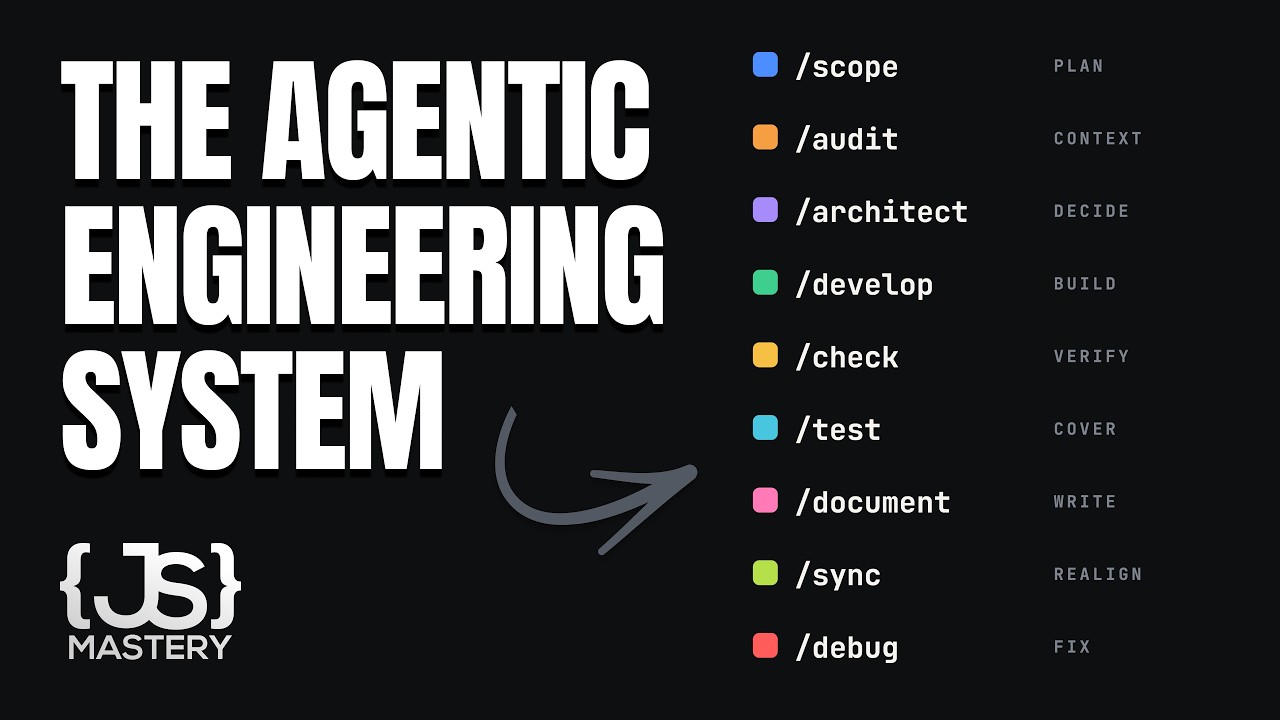
This video teaches a repeatable process for training an AI skill or system prompt like a new employee: build it live from a real task, blind-test it against held-out examples with binary criteria, and run a sub-agent grading loop that surfaces exactly why it failed so you can make the smallest fix possible.
Dylan Davis15 minTranscript found
Quick learning frame
Read this before watching.
AI strategy chooses where agents create durable leverage, then manages scope, adoption, risk, and measurable outcomes.
New playlist item from Dylan Davis; queued for transcript-backed review, topic mapping, and a practical learning artifact.
Skill you build: The ability to design and run a blind-testing and grading loop that proves a skill or system prompt actually meets your quality bar, instead of eyeballing outputs or reusing the same example you built it with.
Watch for the shift from claim to mechanism. The learning value is the point where the transcript reveals a repeatable action, tool boundary, context move, review habit, or artifact.
Concept diagram
Where this video fits.
01Use case
02Workflow pain
03Agent role
04Adoption path
05Risk
06Metric
07Pilot
Deep lesson
Turn this video into working knowledge.
3,760 cleaned transcript words reviewed across 1,040 timed caption segments.
Thesis
I Trained Claude to Work Exactly Like Me teaches a practical ai strategy move: This video teaches a repeatable process for training an AI skill or system prompt like a new employee: build it live from a real task, blind-test it against held-out examples with binary criteria, and run a sub-agent grading loop that surfaces exactly why it failed so you can make the smallest fix possible.
The goal is not to remember the video. The goal is to extract the operating principle, tie it to timestamped evidence, test how far the claim transfers, and make something reusable.
1:13
Prove it first
“tasks we want to outsource to AI that are of high criticality or something we do often. Because often what I see people do is when you interact with AI, this is how they tend to use it.”
Instead of writing a skill from scratch, do the real task live in a conversation with the AI, refining the output until it meets your standard, then ask the AI to encapsulate that process into a skill using two constraints: keep it lean (every line must earn its place) and make it topic-agnostic so it generalizes beyond the one example used to build it. Pick one task you do repeatedly, run it live in a chat until the output is exactly what you want, then use the copy-paste prompt to turn that conversation into a skill.
5:47
Blind test with two piles
“their skills and system prompts, especially those that are critical either there's an important task or something you do a lot. And when doing this testing approach, we need to create two piles of examples. One pile is...”
Split your examples into a build pile (input and output the AI sees while you create the skill) and a hidden test pile (input only); testing the skill on the same example it was built with is invalid because the AI likely memorized the nuance, so you compare its blind output against your own past output using a checklist of 7-10 binary yes/no questions the AI helps you derive. Set aside at least three past examples of your own work as a hidden test pile before you build any skill, and generate a binary checklist from what makes your best examples good.
13:14
Sub-agent grading loop
“that there's too much of a prompt around the smart AI. You need to whittle that prompt down. This is something I've talked about in many other videos in the past, but the TLDR here is that when...”
Have the skill spawn a separate sub-agent grader with fresh context to score the output against the checklist and give a one-line reason for every failed item (a biased parent AI grading its own work tends to pass everything); then feed the AI its output, your manual output, and the failed checklist items, and ask for the smallest possible targeted fix, repeating the loop whenever a new model ships or your standards rise. Add a grading step to one of your skills that spawns a sub-agent to check the output against your checklist and report pass/fail with a one-line reason for each failure.
01
Use case
Start with this video's job: This video teaches a repeatable process for training an AI skill or system prompt like a new employee: build it live from a real task, blind-test it against held-out examples with binary criteria, and run a sub-agent grading loop that surfaces exactly why it failed so you can make the smallest fix possible. Treat "Use case" as the outcome you are trying to make visible, not a topic label. Anchor it to 1:13, where the video says: “tasks we want to outsource to AI that are of high criticality or something we do often. Because often what I see people do is when you interact with AI, this is how they tend to use it.”
02
Workflow pain
Use "Workflow pain" to locate the part of the ai strategy mechanism the video is demonstrating. Ask what changes in your real setup if this claim is true. Anchor it to 5:47, where the video says: “their skills and system prompts, especially those that are critical either there's an important task or something you do a lot. And when doing this testing approach, we need to create two piles of examples. One pile is...”
03
Agent role
Turn "Agent role" into the reusable artifact for this lesson: A one-page AI workflow decision memo with use case, leverage claim, risks, metric, and pilot plan. This is where watching becomes something you can inspect and reuse.
04
Adoption path
Use "Adoption path" as the application surface. Decide whether the idea touches a browser flow, a local file, a model choice, a source document, a UI, or a review step.
05
Risk
Use "Risk" to prove the lesson. The evidence should connect back to the video title, transcript anchors, and a concrete output, not a generic best-practice claim.
06
Metric
Use "Metric" to carry the idea forward: save the prompt, checklist, diagram, or operating rule that would make the next agent run better.
07
Pilot
Connect "Pilot" to I Trained Claude to Work Exactly Like Me by naming the claim, the evidence, and the artifact it should produce.
Example
Source-backed artifact packet
Convert the video into a scoped artifact request that includes the transcript claim, mechanism, acceptance criteria, and proof. The output should be a one-page ai workflow decision memo with use case, leverage claim, risks, metric, and pilot plan..
Example
AI strategy proof brief
Separate what the speaker claims, what the demo actually proves, and what still needs outside verification before you adopt the ai strategy pattern.
Example
Teach-back module
Transform the lesson into a definition, a Use case -> Workflow pain -> Agent role -> Adoption path -> Risk -> Metric -> Pilot diagram, one misconception, one practice exercise, and a check-for-understanding question.
Do not learn it wrong
Treating the title as the lesson without checking what the transcript actually says.
hype laundering
market claims without operational proof
strategy with no pilot
Letting the lesson drift into generic AI business advice.
Letting the lesson drift into unsupported market forecasts.
Letting the lesson drift into no-risk adoption plans.
Do not count this as learned until these are true.
01
State the transcript-backed claim in your own words: This video teaches a repeatable process for training an AI skill or system prompt like a new employee: build it live from a real task, blind-test it against held-out examples with binary criteria, and run a sub-agent grading loop that surfaces exactly why it failed so you can make the smallest fix possible.
02
Explain the practical stakes without hype: New playlist item from Dylan Davis; queued for transcript-backed review, topic mapping, and a practical learning artifact.
03
Map the idea onto the Use case -> Workflow pain -> Agent role -> Adoption path -> Risk -> Metric -> Pilot sequence and name the weakest link.
04
Produce the artifact and include the evidence that proves it: A one-page AI workflow decision memo with use case, leverage claim, risks, metric, and pilot plan.
Put it into practice
Give this grounded prompt to Codex or Claude after watching.
You are helping me turn one specific YouTube video into real, durable learning.

Source video:
- Title: I Trained Claude to Work Exactly Like Me
- URL: https://www.youtube.com/watch?v=IhhxRZDf2bo
- Topic: AI Strategy
- My current learning frame: Take one task you already do by hand, build a skill from a live session, then blind-test it against three hidden examples using a binary checklist and a sub-agent grader, iterating with minimal fixes until every item passes.
- Why this matters: New playlist item from Dylan Davis; queued for transcript-backed review, topic mapping, and a practical learning artifact.

Transcript anchors from this exact video:
- 1:13 / Evidence 1: "tasks we want to outsource to AI that are of high criticality or something we do often. Because often what I see people do is when you interact with AI, this is how they tend to use it."
- 3:49 / Evidence 2: "bloated skills and prompts. Reason being is that the more bloated a skill or prompt is, the less likely the AI is going to follow the task that we gave it accurately. That's the first constraint. The second..."
- 5:47 / Evidence 3: "their skills and system prompts, especially those that are critical either there's an important task or something you do a lot. And when doing this testing approach, we need to create two piles of examples. One pile is..."
- 7:27 / Evidence 4: "this prompt after you've created the skill. So, you've created the skill, then you need to have the criteria to embed in that skill. So, this is going to be a fresh conversation you start with the AI."
- 9:23 / Evidence 5: "baby AI is going to act as a grader. It's going to grade its own work against the criteria we just created. The reason that we're going through the process of creating a sub agent instead of having..."
- 11:03 / Evidence 6: "it, and we've added the additional instruction so the AI grades its own work with a sub-agent. Now, once it's graded the work and it's given us the output back, we need to see did it check off..."
- 13:14 / Evidence 7: "that there's too much of a prompt around the smart AI. You need to whittle that prompt down. This is something I've talked about in many other videos in the past, but the TLDR here is that when..."

Video-aware target:
- Prompt lane: AI strategy
- Mechanism to extract: Separate strategic signal from launch noise by identifying the workflow change and the evidence needed to trust it.
- Artifact to produce: A one-page AI workflow decision memo with use case, leverage claim, risks, metric, and pilot plan.
- Artifact must include: use case; workflow change; risk; metric; pilot scope

Your task:
1. Use the transcript anchors above as the primary source packet. If you add outside context, label it clearly as outside context and keep it secondary.
2. Create a source-check table with columns: timestamp, claim, transcript support, what the demo proves, confidence, and what still needs verification.
3. Extract the actual teachable mechanism from the video: Separate strategic signal from launch noise by identifying the workflow change and the evidence needed to trust it. Do not invent claims that are not supported by the title, lesson frame, or transcript anchors.
4. Build a reusable learning artifact: A one-page AI workflow decision memo with use case, leverage claim, risks, metric, and pilot plan.
5. Include:
   - a plain-English definition of the core idea
   - a diagram or structured model using this sequence: Use case -> Workflow pain -> Agent role -> Adoption path -> Risk -> Metric -> Pilot
   - answers to these source questions: What work changes? | Who benefits? | What evidence would make the claim decision-grade?
   - 3 concrete examples that apply the video idea to real agentic work, such as agent pilot memo; skill-library adoption plan; model-release triage note
   - 2 failure modes the video helps prevent, chosen from the transcript evidence and these likely risks: hype laundering; market claims without operational proof; strategy with no pilot
   - a checklist for the next real workflow, focused on: workflow, leverage, risk, metric, pilot
   - one practical exercise with a clear done signal: Convert one strategy claim into a two-week pilot with a measurable done signal.
6. Add a "learning transfer" section: what changes in my workflow tomorrow if I actually learned this?
7. Add a "source check" section that cites which transcript anchor supports each major takeaway.

Quality bar:
- Make this specific to "I Trained Claude to Work Exactly Like Me", not a generic AI Strategy essay.
- Tie each strategic claim to transcript anchors, then label any market/news context that is not proven by the video.
- Prefer operational examples, failure modes, and reusable artifacts over broad definitions.
- Call out uncertainty instead of smoothing over weak evidence.
- Avoid these generic drifts: generic AI business advice; unsupported market forecasts; no-risk adoption plans.
- If evidence is weak or missing, stop and say what transcript segment or timestamp needs review instead of guessing.
- Finish with a concise artifact I could paste into my learning app.
Misconceptions
What to stop believing.
Every new AI tool deserves a trial.
Every tool has integration cost. Start from workflow pain, not novelty.
If an agent can do it once, it is automated.
Automation means repeatable, monitored, recoverable, and reviewable.
Practice studio
Learning only counts when you make something.
01
Transcript evidence map
Separate what the video actually says from what you already believe about the topic.
3 source-backed takeaways with timestamps, confidence, and a transfer note.02
One useful artifact
Apply the video to a real workflow and produce a one-page ai workflow decision memo with use case, leverage claim, risks, metric, and pilot plan..
A reusable artifact with a done signal and one verification step.03
AI strategy teach-back card
Explain the ai strategy mechanism to someone who has not watched the video yet.
A 90-second explanation, one diagram, one example, and one misconception to avoid.
Recall check
Answer first, then reveal — without rewatching.
What two constraints should you add to the prompt that turns a live conversation into a reusable skill?
Why is it invalid to test a skill using the same example it was built with?
Why does the grading step use a separate sub-agent instead of having the parent AI grade its own output?
Source shelf
Use the video as a doorway, then verify with primary sources.