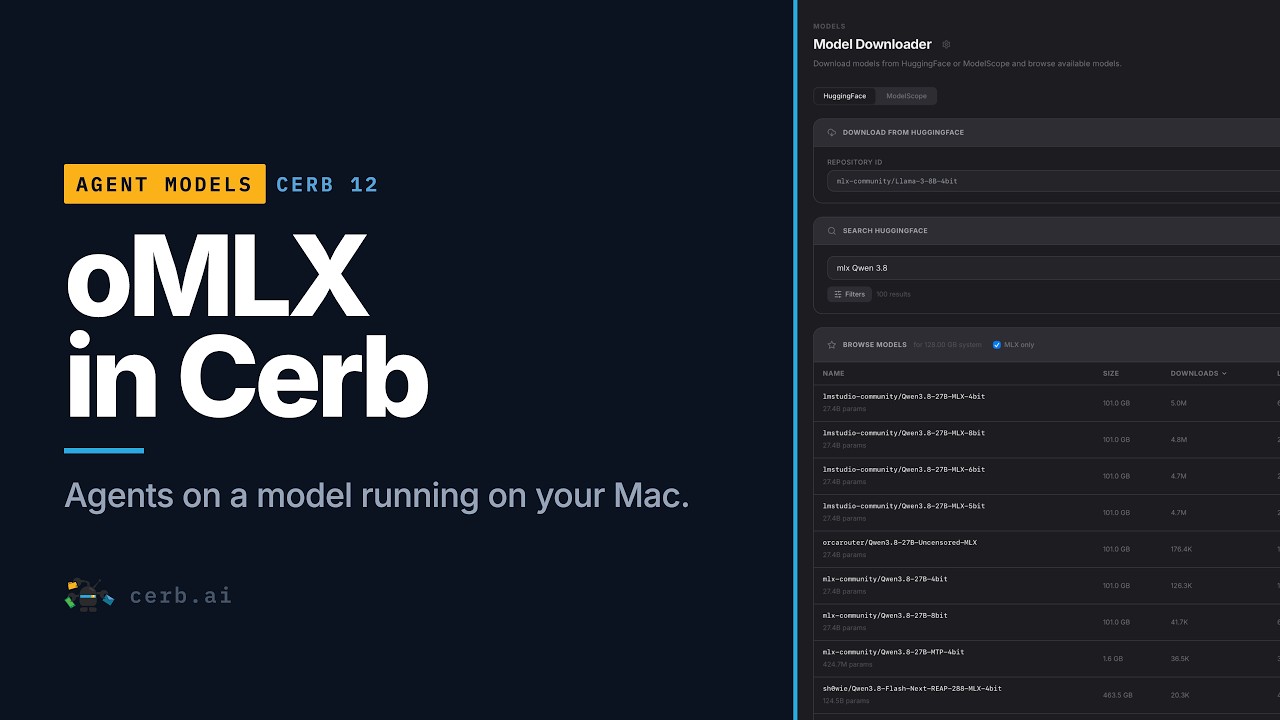
This video explains how Paper Instruments trained Ultramarine for office work by applying reinforcement learning and a small LoRA adapter to the open GLM 5.3 Flash base. It also tests the 60-times-cheaper claim against the company's own benchmark and shows why cost, benchmark ownership, model strength, and unavailable weights all matter when evaluating it.
Cloud Codes9 minTranscript found
Quick learning frame
Read this before watching.
Coding-agent workflow is the loop of inspect, route, plan, edit, verify, summarize, and decide what should be automated next.
New playlist item from Cloud Codes; queued for transcript-backed review, topic mapping, and a practical learning artifact.
Skill you build: The ability to evaluate a low-cost specialized AI model by separating base-model costs from adaptation costs and comparing its grading method, benchmarks, price, and deployment status with realistic alternatives.
Watch for the shift from claim to mechanism. The learning value is the point where the transcript reveals a repeatable action, tool boundary, context move, review habit, or artifact.
Concept diagram
Where this video fits.
01Inspect context
02Route tool
03Plan work
04Edit safely
05Verify behavior
06Report next step
Deep lesson
Turn this video into working knowledge.
1,705 cleaned transcript words reviewed across 498 timed caption segments.
Thesis
A Claude Fable Rival at 60x Less Cost? teaches a practical coding-agent workflow move: This video explains how Paper Instruments trained Ultramarine for office work by applying reinforcement learning and a small LoRA adapter to the open GLM 5.3 Flash base. It also tests the 60-times-cheaper claim against the company's own benchmark and shows why cost, benchmark ownership, model strength, and unavailable weights all matter when evaluating it.
The goal is not to remember the video. The goal is to extract the operating principle, tie it to timestamped evidence, test how far the claim transfers, and make something reusable.
0:16
Borrow the Base
“that claim is about your bill. The same post puts Ultramarine 1 Flash at about Claude Fable 5's level for 60 times less. Reaction posts called it outsiders beating big AI, one stressing no PhDs and no one...”
The reported $300,000 did not fund a model from scratch: Ultramarine starts from ZAI's MIT-licensed GLM 5.3 Flash, whose mixture-of-experts design activates about 18 billion parameters per token. The small team paid for a specialized curriculum and reinforcement-learning layer atop an expensive base another company had already built. Draw a two-layer cost map that separates GLM 5.3 Flash's base-model development from Paper Instruments' office-work adaptation.
3:51
Rubrics Create Rewards
“put deliverables where you're told. The agent tools they surveyed, like OpenCode, CodeX CLI, and QuenCode, start the agent with instructions that run into the thousands of tokens. The longest QuenCode comes to about 4,400. Next to those,...”
Each synthetic office task combines an instruction, a tool-and-file environment, and a point-based grader so subjective work can produce a reinforcement-learning score. In the board-forecast example, correctly revising revenue earns 10 points while treating board approval as legal clearance loses 25, encoding the relative harm of different mistakes. Write a three-line rubric for one document task, including one rewarded fact and one higher-cost error with unequal point values.
7:32
Challenge the Headline
“and releasing it openly, and this split has shown up before. In January 2025, Berkeley's Novasky team fine-tuned an open Qwen model for under $450 and reported results on par with Open AI's 01 preview on reasoning and...”
The 60-times price gap is arithmetically valid on the company's own suite—13 cents per Ultramarine task versus $8.19 for Fable 5—but it is not the whole competitive picture. Stronger models beat Ultramarine, GPT-6 Luna nearly ties it for 11 cents, the benchmark lacks an outside test, and the promised open weights were not yet downloadable. Build a comparison table from the transcript with cost, score position, benchmark independence, and weight availability for Ultramarine and its named rivals.
01
Inspect context
Start with this video's job: This video explains how Paper Instruments trained Ultramarine for office work by applying reinforcement learning and a small LoRA adapter to the open GLM 5.3 Flash base. It also tests the 60-times-cheaper claim against the company's own benchmark and shows why cost, benchmark ownership, model strength, and unavailable weights all matter when evaluating it. Treat "Inspect context" as the outcome you are trying to make visible, not a topic label. Anchor it to 0:16, where the video says: “that claim is about your bill. The same post puts Ultramarine 1 Flash at about Claude Fable 5's level for 60 times less. Reaction posts called it outsiders beating big AI, one stressing no PhDs and no one...”
02
Route tool
Use "Route tool" to locate the part of the coding-agent workflow mechanism the video is demonstrating. Ask what changes in your real setup if this claim is true. Anchor it to 3:51, where the video says: “put deliverables where you're told. The agent tools they surveyed, like OpenCode, CodeX CLI, and QuenCode, start the agent with instructions that run into the thousands of tokens. The longest QuenCode comes to about 4,400. Next to those,...”
03
Plan work
Turn "Plan work" into the reusable artifact for this lesson: A coding-agent routing and execution matrix with context needed, tool choice, verification, and done signal. This is where watching becomes something you can inspect and reuse.
04
Edit safely
Use "Edit safely" as the application surface. Decide whether the idea touches a browser flow, a local file, a model choice, a source document, a UI, or a review step.
05
Verify behavior
Use "Verify behavior" to prove the lesson. The evidence should connect back to the video title, transcript anchors, and a concrete output, not a generic best-practice claim.
06
Report next step
Use "Report next step" to carry the idea forward: save the prompt, checklist, diagram, or operating rule that would make the next agent run better.
Example
Source-backed artifact packet
Convert the video into a scoped artifact request that includes the transcript claim, mechanism, acceptance criteria, and proof. The output should be a coding-agent routing and execution matrix with context needed, tool choice, verification, and done signal..
Example
Coding-agent workflow proof brief
Separate what the speaker claims, what the demo actually proves, and what still needs outside verification before you adopt the coding-agent workflow pattern.
Example
Teach-back module
Transform the lesson into a definition, a Inspect context -> Route tool -> Plan work -> Edit safely -> Verify behavior -> Report next step diagram, one misconception, one practice exercise, and a check-for-understanding question.
Do not learn it wrong
Treating the title as the lesson without checking what the transcript actually says.
choosing tools by hype
losing context across agents
letting parallel sessions become invisible
Letting the lesson drift into generic Codex vs Claude comparison.
Letting the lesson drift into feature lists without task routing.
Letting the lesson drift into claims that ignore limits or recovery.
Do not count this as learned until these are true.
01
State the transcript-backed claim in your own words: This video explains how Paper Instruments trained Ultramarine for office work by applying reinforcement learning and a small LoRA adapter to the open GLM 5.3 Flash base. It also tests the 60-times-cheaper claim against the company's own benchmark and shows why cost, benchmark ownership, model strength, and unavailable weights all matter when evaluating it.
02
Explain the practical stakes without hype: New playlist item from Cloud Codes; queued for transcript-backed review, topic mapping, and a practical learning artifact.
03
Map the idea onto the Use case -> Workflow pain -> Agent role -> Adoption path -> Risk -> Metric -> Pilot sequence and name the weakest link.
04
Produce the artifact and include the evidence that proves it: A one-page AI workflow decision memo with use case, leverage claim, risks, metric, and pilot plan.
Put it into practice
Give this grounded prompt to Codex or Claude after watching.
You are helping me turn one specific YouTube video into real, durable learning.

Source video:
- Title: A Claude Fable Rival at 60x Less Cost?
- URL: https://www.youtube.com/watch?v=GqUiMns5GPg
- Topic: AI Strategy
- My current learning frame: Choose one document-heavy task, define a scored rubric for it, and design a side-by-side test that compares Ultramarine with the best similarly priced model on your own inputs.
- Why this matters: New playlist item from Cloud Codes; queued for transcript-backed review, topic mapping, and a practical learning artifact.

Transcript anchors from this exact video:
- 0:16 / Evidence 1: "that claim is about your bill. The same post puts Ultramarine 1 Flash at about Claude Fable 5's level for 60 times less. Reaction posts called it outsiders beating big AI, one stressing no PhDs and no one..."
- 2:12 / Evidence 2: "tools it can reach. And a grader, the rubric plus the code that runs it, scores whatever the agent hands in. They generated these tasks synthetically across many kinds of office workspace. The report doesn't say which model..."
- 3:51 / Evidence 3: "put deliverables where you're told. The agent tools they surveyed, like OpenCode, CodeX CLI, and QuenCode, start the agent with instructions that run into the thousands of tokens. The longest QuenCode comes to about 4,400. Next to those,..."
- 5:25 / Evidence 4: "price chart was written by the company and graded by another model, GPT 5.6 Tera. No outside test has been published yet. Even WaveX's write-up on switching document work to Ultramarine says it's built from the sources, not..."
- 7:32 / Evidence 5: "and releasing it openly, and this split has shown up before. In January 2025, Berkeley's Novasky team fine-tuned an open Qwen model for under $450 and reported results on par with Open AI's 01 preview on reasoning and..."
- 9:08 / Evidence 6: "a giant lab as long as one already shipped the base. Which task at your job would you trust to a rubric first?"

Video-aware target:
- Prompt lane: Coding-agent workflow
- Mechanism to extract: Find the workflow rule that explains when and how to use Codex, Claude Code, browser control, dashboards, or manual review.
- Artifact to produce: A coding-agent routing and execution matrix with context needed, tool choice, verification, and done signal.
- Artifact must include: task class; agent/tool choice; context packet; verification step; handoff/recovery rule

Your task:
1. Use the transcript anchors above as the primary source packet. If you add outside context, label it clearly as outside context and keep it secondary.
2. Create a source-check table with columns: timestamp, claim, transcript support, what the demo proves, confidence, and what still needs verification.
3. Extract the actual teachable mechanism from the video: Find the workflow rule that explains when and how to use Codex, Claude Code, browser control, dashboards, or manual review. Do not invent claims that are not supported by the title, lesson frame, or transcript anchors.
4. Build a reusable learning artifact: A coding-agent routing and execution matrix with context needed, tool choice, verification, and done signal.
5. Include:
   - a plain-English definition of the core idea
   - a diagram or structured model using this sequence: Inspect context -> Route tool -> Plan work -> Edit safely -> Verify behavior -> Report next step
   - answers to these source questions: What workflow pain is being solved? | What exact coordination mechanism is shown? | What evidence proves it changes the work?
   - 3 concrete examples that apply the video idea to real agentic work, such as rate-limit routing; browser verification after a UI edit; long-running /goal session review
   - 2 failure modes the video helps prevent, chosen from the transcript evidence and these likely risks: choosing tools by hype; losing context across agents; letting parallel sessions become invisible
   - a checklist for the next real workflow, focused on: routing decision, context portability, verification, handoff summary
   - one practical exercise with a clear done signal: Route three recent tasks across Codex, Claude, browser checks, and manual review with a reason for each.
6. Add a "learning transfer" section: what changes in my workflow tomorrow if I actually learned this?
7. Add a "source check" section that cites which transcript anchor supports each major takeaway.

Quality bar:
- Make this specific to "A Claude Fable Rival at 60x Less Cost?", not a generic AI Strategy essay.
- Each workflow rule must point to a timestamped claim or demo moment, then state what remains unproven.
- Prefer operational examples, failure modes, and reusable artifacts over broad definitions.
- Call out uncertainty instead of smoothing over weak evidence.
- Avoid these generic drifts: generic Codex vs Claude comparison; feature lists without task routing; claims that ignore limits or recovery.
- If evidence is weak or missing, stop and say what transcript segment or timestamp needs review instead of guessing.
- Finish with a concise artifact I could paste into my learning app.
Misconceptions
What to stop believing.
Every new AI tool deserves a trial.
Every tool has integration cost. Start from workflow pain, not novelty.
If an agent can do it once, it is automated.
Automation means repeatable, monitored, recoverable, and reviewable.
Practice studio
Learning only counts when you make something.
01
Transcript evidence map
Separate what the video actually says from what you already believe about the topic.
3 source-backed takeaways with timestamps, confidence, and a transfer note.02
One useful artifact
Apply the video to a real workflow and produce a coding-agent routing and execution matrix with context needed, tool choice, verification, and done signal..
A reusable artifact with a done signal and one verification step.03
Coding-agent workflow teach-back card
Explain the coding-agent workflow mechanism to someone who has not watched the video yet.
A 90-second explanation, one diagram, one example, and one misconception to avoid.
Recall check
Answer first, then reveal — without rewatching.
Why could a five-person team report training Ultramarine for about $300,000?
How did Ultramarine's training turn subjective office work into a reinforcement-learning signal?
What limits the headline claim that Ultramarine matches Fable 5 for 60 times less?
Source shelf
Use the video as a doorway, then verify with primary sources.