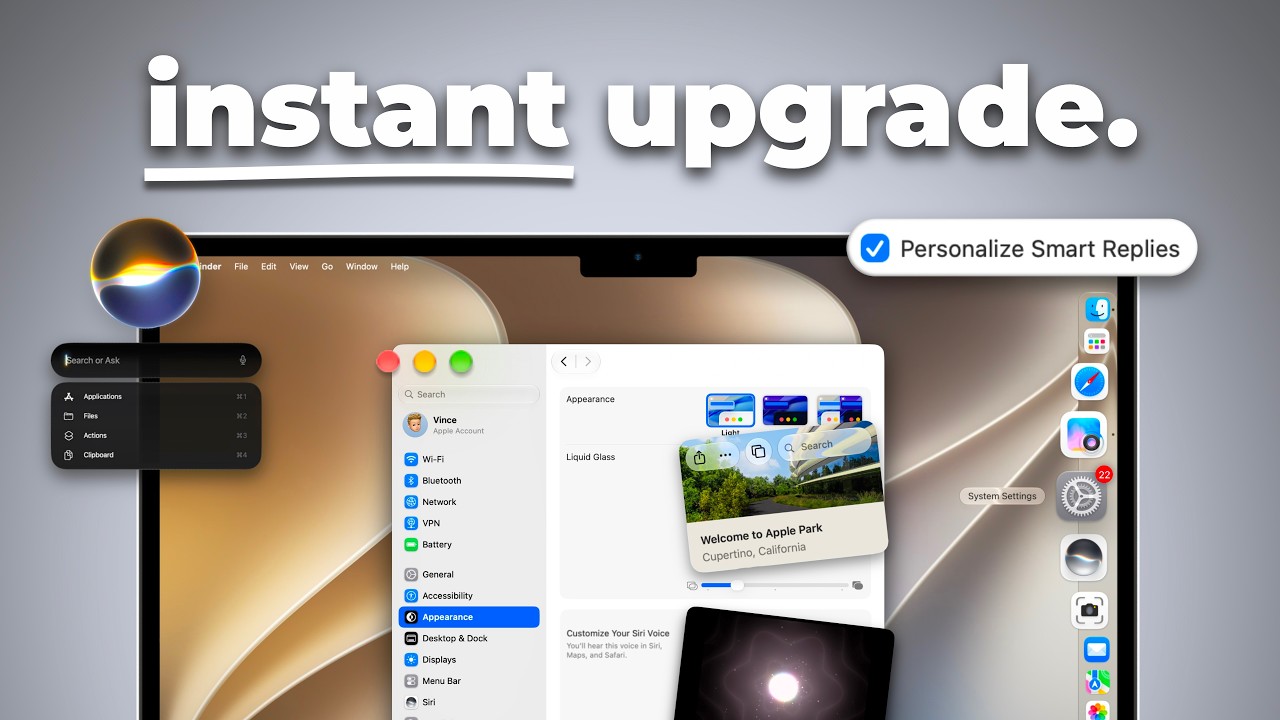
Simon Scrapes dissects why Claude Code's memory is weak out of the box and rebuilds a complete agent memory system by cherry-picking the best ideas from open-source projects: cited answers from GBrain, Hermes-style frozen snapshot injection, memsearch-style hybrid semantic search, and team-scoped access — implemented on a local PG Lite + pgvector store with row-level security.
Simon Scrapes15 minTranscript found
Quick learning frame
Read this before watching.
Agent ops treats agents like services: observable state, queues, permissions, logs, recovery, and post-run review.
New playlist item from Simon Scrapes; queued for transcript-backed review, topic mapping, and a practical learning artifact.
Skill you build: The ability to design an agent memory architecture by answering the three core questions — how memories are stored, what gets injected at session start, and how recall works — and selecting the right framework pattern for each instead of installing one off the shelf.
Watch for the shift from claim to mechanism. The learning value is the point where the transcript reveals a repeatable action, tool boundary, context move, review habit, or artifact.
Concept diagram
Where this video fits.
01Project state
02Session
03Queue/Kanban
04Tools
05Logs
06Recovery
07Post-run review
Deep lesson
Turn this video into working knowledge.
3,399 cleaned transcript words reviewed across 1,000 timed caption segments.
Thesis
Claude Code Agentic OS… It Remembers Everything teaches a practical hermes operations move: Simon Scrapes dissects why Claude Code's memory is weak out of the box and rebuilds a complete agent memory system by cherry-picking the best ideas from open-source projects: cited answers from GBrain, Hermes-style frozen snapshot injection, memsearch-style hybrid semantic search, and team-scoped access — implemented on a local PG Lite + pgvector store with row-level security.
The goal is not to remember the video. The goal is to extract the operating principle, tie it to timestamped evidence, test how far the claim transfers, and make something reusable.
0:00
Four pillars of memory
“For a tool this good, Claude Code's memory is embarrassingly bad out of the box. Decisions you've already made, context you've explained before, and work you've already done. It forgets all of it. And after a while, that...”
Perfect business memory does four things: cites its sources with the exact conversation, words, and date (from GBrain, and admits when it doesn't know), injects a small capped snapshot of recent context via a hook at session start (Hermes' frozen snapshot), searches long-term by meaning so 'payment processing' finds Stripe (memsearch-style hybrid vector plus keyword search), and scopes access so teammates only see their own clients. Score your current agent setup 0-2 on each of the four pillars — citations, snapshot injection, semantic search, and scoping — and identify which gap costs you the most re-explaining.
4:50
Why default memory fails
“Automemory you can see is on. Let's go and open the automemory folder. What we can see, by the way, in a repo that I've been running for months, is quite literally two files. An index file, memory.md,...”
Every memory system answers three questions — storage, injection, recall — and Claude Code is weak at all three: after months of use its automemory folder held just an index with one reference and a single project file, sessions load little beyond claude.md, and recall means token-heavy keyword trawling through old sessions or resuming by conversation ID, so a question like 'what did we agree in that client meeting 6 months ago' won't come back reliably. Run /memory in Claude Code and open your automemory folder to count what has actually been captured — then note three decisions from the past month it never recorded.
11:07
The end-to-end pipeline
“loaded in? All of that short-term memory is actually being injected into the next session. So it's a frozen snapshot that when you restart Claude and go into the next session, it's going to be injected into that...”
In his build, a stop hook judges each turn: durable facts (decisions, price changes, preferences) go into a capped memory.md with de-duplication, while everything gets chunked and embedded into a PG Lite + pgvector store — chosen over memsearch for no external dependencies, Windows support, and per-user row-level security. Retrieval is three-tier: short-term context first, then vector plus keyword search pulling the top 5-10 chunks, reranked and returned as a synthesized, cited answer. Sketch this pipeline as a diagram — stop hook, short-term memory.md, long-term vector store, three-tier retrieval with reranking — and mark which piece you could implement first with a single hook.
01
Project state
Start with this video's job: Simon Scrapes dissects why Claude Code's memory is weak out of the box and rebuilds a complete agent memory system by cherry-picking the best ideas from open-source projects: cited answers from GBrain, Hermes-style frozen snapshot injection, memsearch-style hybrid semantic search, and team-scoped access — implemented on a local PG Lite + pgvector store with row-level security. Treat "Project state" as the outcome you are trying to make visible, not a topic label. Anchor it to 0:00, where the video says: “For a tool this good, Claude Code's memory is embarrassingly bad out of the box. Decisions you've already made, context you've explained before, and work you've already done. It forgets all of it. And after a while, that...”
02
Session
Use "Session" to locate the part of the hermes operations mechanism the video is demonstrating. Ask what changes in your real setup if this claim is true. Anchor it to 4:50, where the video says: “Automemory you can see is on. Let's go and open the automemory folder. What we can see, by the way, in a repo that I've been running for months, is quite literally two files. An index file, memory.md,...”
03
Queue/Kanban
Turn "Queue/Kanban" into the reusable artifact for this lesson: A Hermes-style agent-ops runbook with health checks, state transitions, logs, recovery steps, and review criteria. This is where watching becomes something you can inspect and reuse.
04
Tools
Use "Tools" as the application surface. Decide whether the idea touches a browser flow, a local file, a model choice, a source document, a UI, or a review step.
05
Logs
Use "Logs" to prove the lesson. The evidence should connect back to the video title, transcript anchors, and a concrete output, not a generic best-practice claim.
06
Recovery
Use "Recovery" to carry the idea forward: save the prompt, checklist, diagram, or operating rule that would make the next agent run better.
07
Post-run review
Connect "Post-run review" to Claude Code Agentic OS… It Remembers Everything by naming the claim, the evidence, and the artifact it should produce.
Example
Source-backed artifact packet
Convert the video into a scoped artifact request that includes the transcript claim, mechanism, acceptance criteria, and proof. The output should be a hermes-style agent-ops runbook with health checks, state transitions, logs, recovery steps, and review criteria..
Example
Hermes operations proof brief
Separate what the speaker claims, what the demo actually proves, and what still needs outside verification before you adopt the hermes operations pattern.
Example
Teach-back module
Transform the lesson into a definition, a Project state -> Session -> Queue/Kanban -> Tools -> Logs -> Recovery -> Post-run review diagram, one misconception, one practice exercise, and a check-for-understanding question.
Do not learn it wrong
Treating the title as the lesson without checking what the transcript actually says.
treating UI features as reliability
missing logs
no stop/recover path
Letting the lesson drift into feature cheerleading.
Letting the lesson drift into ops advice without logs/state.
Letting the lesson drift into assuming reliability from a demo alone.
Do not count this as learned until these are true.
01
State the transcript-backed claim in your own words: Simon Scrapes dissects why Claude Code's memory is weak out of the box and rebuilds a complete agent memory system by cherry-picking the best ideas from open-source projects: cited answers from GBrain, Hermes-style frozen snapshot injection, memsearch-style hybrid semantic search, and team-scoped access — implemented on a local PG Lite + pgvector store with row-level security.
02
Explain the practical stakes without hype: New playlist item from Simon Scrapes; queued for transcript-backed review, topic mapping, and a practical learning artifact.
03
Map the idea onto the Project state -> Session -> Queue/Kanban -> Tools -> Logs -> Recovery -> Post-run review sequence and name the weakest link.
04
Produce the artifact and include the evidence that proves it: A Hermes-style agent-ops runbook with health checks, state transitions, logs, recovery steps, and review criteria.
Put it into practice
Give this grounded prompt to Codex or Claude after watching.
You are helping me turn one specific YouTube video into real, durable learning.

Source video:
- Title: Claude Code Agentic OS… It Remembers Everything
- URL: https://www.youtube.com/watch?v=F4At4St1iH8
- Topic: Creative Automation
- My current learning frame: Build a minimal version of the frozen snapshot pattern: create a capped memory.md of your top recent decisions and preferences, wire a hook to inject it at session start, and test whether Claude answers a week-old question correctly without you re-explaining.
- Why this matters: New playlist item from Simon Scrapes; queued for transcript-backed review, topic mapping, and a practical learning artifact.

Transcript anchors from this exact video:
- 0:00 / Evidence 1: "For a tool this good, Claude Code's memory is embarrassingly bad out of the box. Decisions you've already made, context you've explained before, and work you've already done. It forgets all of it. And after a while, that..."
- 2:38 / Evidence 2: "recognize that that context was important and relevant. And what I've just described is semantic search and the approach comes from vector databases more generally, but for agent memory frameworks, it's used heavily by a few different open..."
- 4:50 / Evidence 3: "Automemory you can see is on. Let's go and open the automemory folder. What we can see, by the way, in a repo that I've been running for months, is quite literally two files. An index file, memory.md,..."
- 7:52 / Evidence 4: "memory.md, which is curated set of recent context memories, not like Claude's automemory, and they also inject the daily memory of the work that's been done today. So it's basically like a capped amount of frozen memory that..."
- 9:31 / Evidence 5: "semantic and keyword hybrid search, but we upgraded it to PG Lite and PG Vector for three reasons. Firstly, there's no external dependencies, so it can just run locally on your PC if you don't need to share..."
- 11:07 / Evidence 6: "loaded in? All of that short-term memory is actually being injected into the next session. So it's a frozen snapshot that when you restart Claude and go into the next session, it's going to be injected into that..."
- 14:07 / Evidence 7: "to contribute. So we're enabling some key files like brand context and claude.md to have their source of truth in notion or Google drive. claw code is going to handle things like skills and memory functions everything you..."

Video-aware target:
- Prompt lane: Hermes operations
- Mechanism to extract: Identify the operations control that makes long-running agent work visible, recoverable, or safer.
- Artifact to produce: A Hermes-style agent-ops runbook with health checks, state transitions, logs, recovery steps, and review criteria.
- Artifact must include: health check; state model; permission boundary; log source; recovery action

Your task:
1. Use the transcript anchors above as the primary source packet. If you add outside context, label it clearly as outside context and keep it secondary.
2. Create a source-check table with columns: timestamp, claim, transcript support, what the demo proves, confidence, and what still needs verification.
3. Extract the actual teachable mechanism from the video: Identify the operations control that makes long-running agent work visible, recoverable, or safer. Do not invent claims that are not supported by the title, lesson frame, or transcript anchors.
4. Build a reusable learning artifact: A Hermes-style agent-ops runbook with health checks, state transitions, logs, recovery steps, and review criteria.
5. Include:
   - a plain-English definition of the core idea
   - a diagram or structured model using this sequence: Project state -> Session -> Queue/Kanban -> Tools -> Logs -> Recovery -> Post-run review
   - answers to these source questions: What operational failure is prevented? | What state is visible? | What can be recovered or redirected?
   - 3 concrete examples that apply the video idea to real agentic work, such as Hermes Kanban triage; local model endpoint check; agent swarm recovery review
   - 2 failure modes the video helps prevent, chosen from the transcript evidence and these likely risks: treating UI features as reliability; missing logs; no stop/recover path
   - a checklist for the next real workflow, focused on: status, model/backend, tools, logs, recovery
   - one practical exercise with a clear done signal: Write a runbook for restarting one stuck Hermes-style agent session.
6. Add a "learning transfer" section: what changes in my workflow tomorrow if I actually learned this?
7. Add a "source check" section that cites which transcript anchor supports each major takeaway.

Quality bar:
- Make this specific to "Claude Code Agentic OS… It Remembers Everything", not a generic Creative Automation essay.
- Ground each ops recommendation in transcript evidence about state, queues, models, tools, security, logs, or recovery.
- Prefer operational examples, failure modes, and reusable artifacts over broad definitions.
- Call out uncertainty instead of smoothing over weak evidence.
- Avoid these generic drifts: feature cheerleading; ops advice without logs/state; assuming reliability from a demo alone.
- If evidence is weak or missing, stop and say what transcript segment or timestamp needs review instead of guessing.
- Finish with a concise artifact I could paste into my learning app.
Misconceptions
What to stop believing.
Creative AI removes the need for taste.
It increases the need for taste because output volume explodes.
The best prompt is enough.
References, critique, iteration, and post-production matter just as much.
Practice studio
Learning only counts when you make something.
01
Transcript evidence map
Separate what the video actually says from what you already believe about the topic.
3 source-backed takeaways with timestamps, confidence, and a transfer note.02
One useful artifact
Apply the video to a real workflow and produce a hermes-style agent-ops runbook with health checks, state transitions, logs, recovery steps, and review criteria..
A reusable artifact with a done signal and one verification step.03
Hermes operations teach-back card
Explain the hermes operations mechanism to someone who has not watched the video yet.
A 90-second explanation, one diagram, one example, and one misconception to avoid.
Recall check
Answer first, then reveal — without rewatching.
Which open-source project inspired each of the four pillars of the 'perfect memory' system?
What evidence does the video give that Claude Code's automemory barely captures anything?
Why did he replace memsearch with PG Lite and pgvector for long-term storage?
Source shelf
Use the video as a doorway, then verify with primary sources.