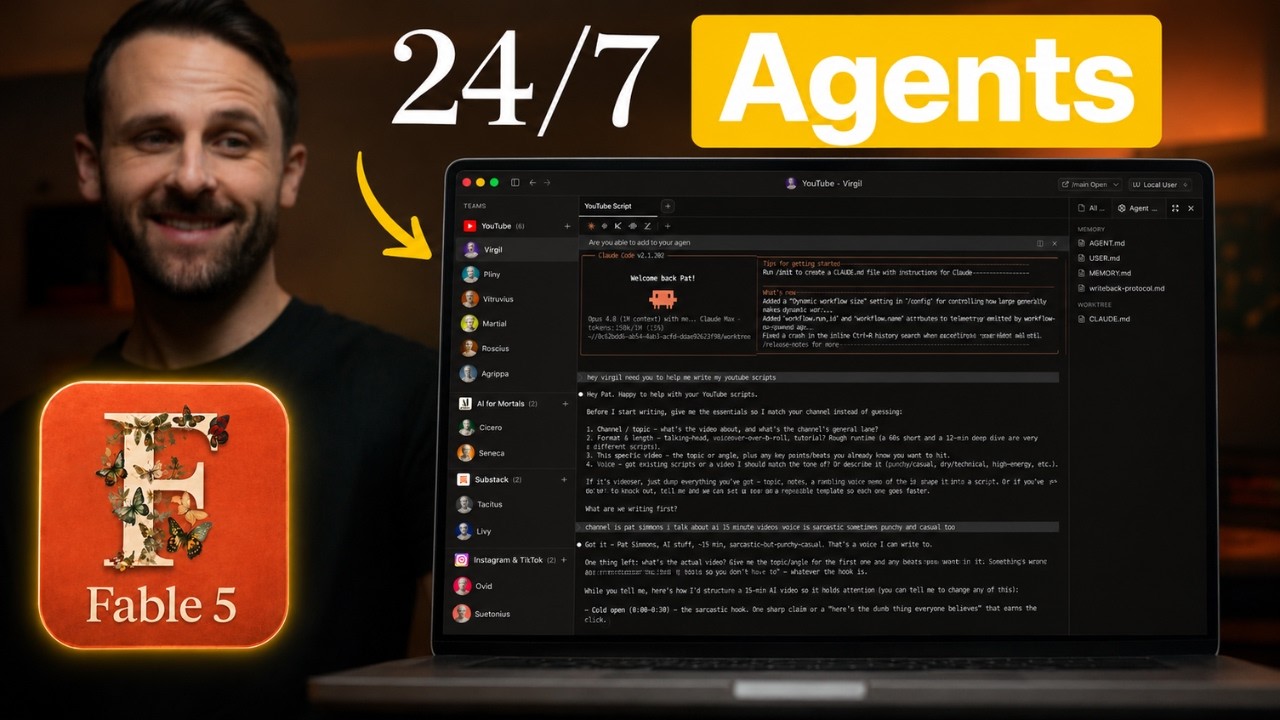
Hermes Agent powered by local models on the DGX Spark is basically magic
Run Hermes against local models and specialized hardware by separating the agent UI, model endpoint, project state, and verification loop.
Alex Finn24 minTranscript found
Quick learning frame
Read this before watching.
A local runtime lesson is about fit: model, quantization, hardware, endpoint, latency, privacy, tool integration, and task limits.
This is a useful bridge between local model infrastructure and the Hermes-style agent operations surface already tracked in the atlas.
Skill you build: The ability to run a private, always-on local AI agent on your own hardware and wire it into scheduled and coding workflows without paying per token.
Watch for the shift from claim to mechanism. The learning value is the point where the transcript reveals a repeatable action, tool boundary, context move, review habit, or artifact.
Concept diagram
Where this video fits.
01Task
02Hardware
03Model/quantization
04Runtime endpoint
05Agent tool loop
06Benchmark task
07Fallback
Deep lesson
Turn this video into working knowledge.
5,033 cleaned transcript words reviewed across 1,376 timed caption segments.
Thesis
Hermes Agent powered by local models on the DGX Spark is basically magic teaches a practical local model/runtime move: Run Hermes against local models and specialized hardware by separating the agent UI, model endpoint, project state, and verification loop.
The goal is not to remember the video. The goal is to extract the operating principle, tie it to timestamped evidence, test how far the claim transfers, and make something reusable.
0:00
Why local models
“Okay, so this is really sick. I just set up a Hermes agent on this Nvidia DGX Spark completely powered by a local model that's running on it. I now have an AI agent, a 247 AI employee...”
Local models are effectively free (you pay only electricity and the computer), completely private (unplug the internet and it still works, no chat logs in the cloud), customizable via LoRAs, educational, and unlock 24/7 use cases because running a model round-the-clock costs only power, not per-token cloud fees. Write down which of the stated benefits (free, private, customizable, always-on) matters most for a task you'd hand a local agent, and why.
6:44
Headless setup with Tailscale
“whatever you want. We can now get to work in setting up our local models and setting up our new DGX Spark. Now that we got the Spark plugged in, this is the prompt I'm going to give...”
The DGX Spark runs headless (no monitor) and starts its own network you join from your main device; the prompt has Hermes Agent walk through setup and install Tailscale so all your devices share one private network, letting the agent control the Spark, install the Qwen 3.6 27B model, and be reachable anywhere. Draft the plain-English prompt you'd give an agent to set up a headless box and install Tailscale so it can be controlled from any device.
20:42
Three local use cases
“that is vibe coding. We are going to have our Hermes agent vibe code a to-do list app for So very simple, just for demonstration purposes, you can now have your local models do vibe coding for you.”
With Qwen wired into a second Hermes profile, he shows a beginner case (a cron job scheduling a 9am daily AI-stock moat report), a moderate case (fetch a YouTube transcript and repurpose it into a newsletter, even self-improving hourly since there's no token cost), and an advanced case (vibe-code a to-do app entirely locally). Set up one scheduled cron-job task on a local agent (e.g., a daily research report) and confirm it runs on schedule.
01
Task
Start with this video's job: Run Hermes against local models and specialized hardware by separating the agent UI, model endpoint, project state, and verification loop. Treat "Task" as the outcome you are trying to make visible, not a topic label. Anchor it to 0:00, where the video says: “Okay, so this is really sick. I just set up a Hermes agent on this Nvidia DGX Spark completely powered by a local model that's running on it. I now have an AI agent, a 247 AI employee...”
02
Hardware
Use "Hardware" to locate the part of the local model/runtime mechanism the video is demonstrating. Ask what changes in your real setup if this claim is true. Anchor it to 6:44, where the video says: “whatever you want. We can now get to work in setting up our local models and setting up our new DGX Spark. Now that we got the Spark plugged in, this is the prompt I'm going to give...”
03
Model/quantization
Turn "Model/quantization" into the reusable artifact for this lesson: A local model/runtime fit sheet with hardware constraints, model choice, endpoint setup, task benchmark, and fallback rule. This is where watching becomes something you can inspect and reuse.
04
Runtime endpoint
Use "Runtime endpoint" as the application surface. Decide whether the idea touches a browser flow, a local file, a model choice, a source document, a UI, or a review step.
05
Agent tool loop
Use "Agent tool loop" to prove the lesson. The evidence should connect back to the video title, transcript anchors, and a concrete output, not a generic best-practice claim.
06
Benchmark task
Use "Benchmark task" to carry the idea forward: save the prompt, checklist, diagram, or operating rule that would make the next agent run better.
07
Fallback
Connect "Fallback" to Hermes Agent powered by local models on the DGX Spark is basically magic by naming the claim, the evidence, and the artifact it should produce.
Example
Source-backed artifact packet
Convert the video into a scoped artifact request that includes the transcript claim, mechanism, acceptance criteria, and proof. The output should be a local model/runtime fit sheet with hardware constraints, model choice, endpoint setup, task benchmark, and fallback rule..
Example
Local model/runtime proof brief
Separate what the speaker claims, what the demo actually proves, and what still needs outside verification before you adopt the local model/runtime pattern.
Example
Teach-back module
Transform the lesson into a definition, a Task -> Hardware -> Model/quantization -> Runtime endpoint -> Agent tool loop -> Benchmark task -> Fallback diagram, one misconception, one practice exercise, and a check-for-understanding question.
Do not learn it wrong
Treating the title as the lesson without checking what the transcript actually says.
using a local model like ChatGPT
ignoring latency/context limits
no benchmark task
Letting the lesson drift into local-model ideology.
Letting the lesson drift into hardware specs without workflow fit.
Letting the lesson drift into benchmarks unrelated to the actual task.
Do not count this as learned until these are true.
01
State the transcript-backed claim in your own words: Run Hermes against local models and specialized hardware by separating the agent UI, model endpoint, project state, and verification loop.
02
Explain the practical stakes without hype: This is a useful bridge between local model infrastructure and the Hermes-style agent operations surface already tracked in the atlas.
03
Map the idea onto the Task -> Hardware -> Model/quantization -> Runtime endpoint -> Agent tool loop -> Benchmark task -> Fallback sequence and name the weakest link.
04
Produce the artifact and include the evidence that proves it: A local model/runtime fit sheet with hardware constraints, model choice, endpoint setup, task benchmark, and fallback rule.
Put it into practice
Give this grounded prompt to Codex or Claude after watching.
You are helping me turn one specific YouTube video into real, durable learning.

Source video:
- Title: Hermes Agent powered by local models on the DGX Spark is basically magic
- URL: https://www.youtube.com/watch?v=7JRHSo2F-Wk
- Topic: Hermes + Agent Ops
- My current learning frame: Plug in a local-model box, prompt Hermes Agent to set it up headless with Tailscale and load Qwen 3.6 27B, create a Hermes profile pointed at it, then schedule a daily report and repurpose a YouTube transcript to prove the free local workflow end to end.
- Why this matters: This is a useful bridge between local model infrastructure and the Hermes-style agent operations surface already tracked in the atlas.

Transcript anchors from this exact video:
- 0:00 / Evidence 1: "Okay, so this is really sick. I just set up a Hermes agent on this Nvidia DGX Spark completely powered by a local model that's running on it. I now have an AI agent, a 247 AI employee..."
- 1:33 / Evidence 2: "months ago. So that's why this was really easy for me to do. But let's get into this. Let's talk about local models, what makes them so amazing, and why it's so powerful with Hermes Agent. Then we'll..."
- 6:44 / Evidence 3: "whatever you want. We can now get to work in setting up our local models and setting up our new DGX Spark. Now that we got the Spark plugged in, this is the prompt I'm going to give..."
- 12:00 / Evidence 4: "chat interface for our model. This allows you just test it real quick and kind of feel that magical moment of, oh my god, Super Intelligence is talking to me locally. So, do this. Please build a front..."
- 14:08 / Evidence 5: "It found the Llama server where the uh local model is running. It's going to ask us for permission. Let's give it the okay on this, and it's going to start getting to work building out that new..."
- 20:42 / Evidence 6: "that is vibe coding. We are going to have our Hermes agent vibe code a to-do list app for So very simple, just for demonstration purposes, you can now have your local models do vibe coding for you."
- 23:54 / Evidence 7: "Let me know down below in the comments what you want to see next. Do you want to see more use cases for Hermes agents? Do you want to see more advanced workflows? I'd love to hear your..."

Video-aware target:
- Prompt lane: Local model/runtime
- Mechanism to extract: Identify why the local setup works or fails for this specific agent task, not whether local models are generally good.
- Artifact to produce: A local model/runtime fit sheet with hardware constraints, model choice, endpoint setup, task benchmark, and fallback rule.
- Artifact must include: hardware; runtime; model/quantization; endpoint; agent integration; benchmark/fallback

Your task:
1. Use the transcript anchors above as the primary source packet. If you add outside context, label it clearly as outside context and keep it secondary.
2. Create a source-check table with columns: timestamp, claim, transcript support, what the demo proves, confidence, and what still needs verification.
3. Extract the actual teachable mechanism from the video: Identify why the local setup works or fails for this specific agent task, not whether local models are generally good. Do not invent claims that are not supported by the title, lesson frame, or transcript anchors.
4. Build a reusable learning artifact: A local model/runtime fit sheet with hardware constraints, model choice, endpoint setup, task benchmark, and fallback rule.
5. Include:
   - a plain-English definition of the core idea
   - a diagram or structured model using this sequence: Task -> Hardware -> Model/quantization -> Runtime endpoint -> Agent tool loop -> Benchmark task -> Fallback
   - answers to these source questions: What machine/runtime is shown? | What task exposes the model limit? | What setup change improves the loop?
   - 3 concrete examples that apply the video idea to real agentic work, such as Ollama or LM Studio coding endpoint; MLX Apple Silicon runner; DGX-backed Hermes session
   - 2 failure modes the video helps prevent, chosen from the transcript evidence and these likely risks: using a local model like ChatGPT; ignoring latency/context limits; no benchmark task
   - a checklist for the next real workflow, focused on: task fit, runtime setup, latency/context, tool loop, fallback
   - one practical exercise with a clear done signal: Choose one real coding task and specify the pass/fail benchmark for a local model.
6. Add a "learning transfer" section: what changes in my workflow tomorrow if I actually learned this?
7. Add a "source check" section that cites which transcript anchor supports each major takeaway.

Quality bar:
- Make this specific to "Hermes Agent powered by local models on the DGX Spark is basically magic", not a generic Hermes + Agent Ops essay.
- Tie each harness element to a transcript anchor that names a tool, state boundary, permission, model behavior, or verification step.
- Prefer operational examples, failure modes, and reusable artifacts over broad definitions.
- Call out uncertainty instead of smoothing over weak evidence.
- Avoid these generic drifts: local-model ideology; hardware specs without workflow fit; benchmarks unrelated to the actual task.
- If evidence is weak or missing, stop and say what transcript segment or timestamp needs review instead of guessing.
- Finish with a concise artifact I could paste into my learning app.
Misconceptions
What to stop believing.
A chat UI is an agent operating system.
A chat UI is only the surface. Ops requires state, logs, permissions, queues, and recovery.
Swarms are automatically more powerful.
Parallel agents help only when work is separable and verifiable.
Practice studio
Learning only counts when you make something.
01
Transcript evidence map
Separate what the video actually says from what you already believe about the topic.
3 source-backed takeaways with timestamps, confidence, and a transfer note.02
One useful artifact
Apply the video to a real workflow and produce a local model/runtime fit sheet with hardware constraints, model choice, endpoint setup, task benchmark, and fallback rule..
A reusable artifact with a done signal and one verification step.03
Local model/runtime teach-back card
Explain the local model/runtime mechanism to someone who has not watched the video yet.
A 90-second explanation, one diagram, one example, and one misconception to avoid.
Recall check
Answer first, then reveal — without rewatching.
What are the main advantages of running a local model instead of a cloud one?
How is the DGX Spark set up, and why is Tailscale installed?
What three local Hermes use cases does the creator demonstrate with Qwen 3.6 27B?
Source shelf
Use the video as a doorway, then verify with primary sources.