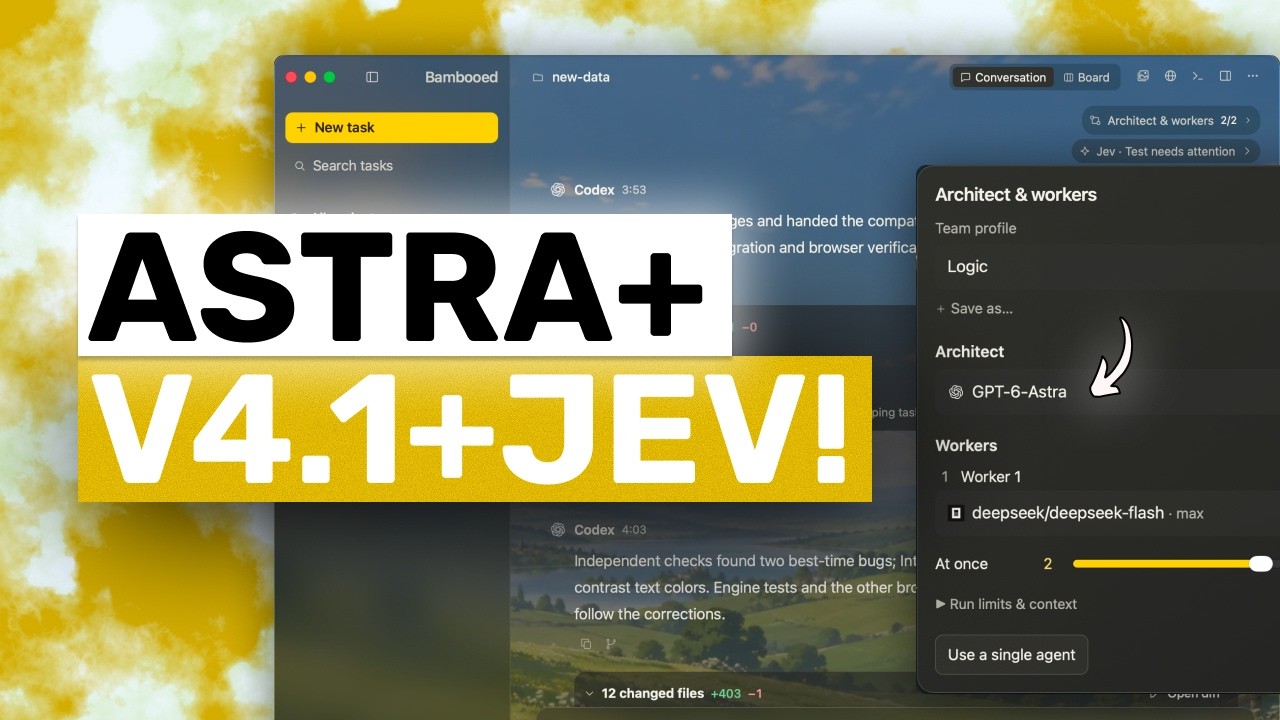
This video rapid-fire showcases 35 trending GitHub projects from one week, heavily weighted toward AI-agent infrastructure: local inference engines for Apple Silicon and Blackwell GPUs, agent sandboxing and orchestration tools, and cost-routing setups that pair frontier models with cheaper junior models.
Github Awesome15 minTranscript found
Quick learning frame
Read this before watching.
A local runtime lesson is about fit: model, quantization, hardware, endpoint, latency, privacy, tool integration, and task limits.
New playlist item from Github Awesome; queued for transcript-backed review, topic mapping, and a practical learning artifact.
Skill you build: Building a working mental map of the current open-source AI-agent tooling landscape so you can recognize which category a new project fits (inference engine, agent sandbox, orchestrator, spec-writer, cost router) and evaluate it quickly.
Watch for the shift from claim to mechanism. The learning value is the point where the transcript reveals a repeatable action, tool boundary, context move, review habit, or artifact.
Concept diagram
Where this video fits.
01Task
02Hardware
03Model/quantization
04Runtime endpoint
05Agent tool loop
06Benchmark task
07Fallback
Deep lesson
Turn this video into working knowledge.
2,208 cleaned transcript words reviewed across 764 timed caption segments.
Thesis
GitHub Trending Weekly #33: mirage, deepsec, trust, OpenSwarm, tokenspeed, avnac, ds4, gemma-chat teaches a practical local model/runtime move: This video rapid-fire showcases 35 trending GitHub projects from one week, heavily weighted toward AI-agent infrastructure: local inference engines for Apple Silicon and Blackwell GPUs, agent sandboxing and orchestration tools, and cost-routing setups that pair frontier models with cheaper junior models.
The goal is not to remember the video. The goal is to extract the operating principle, tie it to timestamped evidence, test how far the claim transfers, and make something reusable.
0:38
Agent filesystem abstraction
“harness orchestrating coding agents like clawed opus 4.7 or GPT 5.5 to investigate your entire codebase. Multi-stage workflow flags sensitive files, traces data flows, checks mitigations, then a revalidate pass aggressively cuts false positives. Fan out across a...”
Mirage exposes S3, Google Drive, GitHub, Postgres, and Reddit as a single Unix filesystem so an LLM agent can manipulate them with the bash tools it already knows (cat, grep, wc) rather than bespoke APIs, with git-like snapshot/clone/rollback over the whole workspace. List three external data sources you'd want an agent to touch and sketch how each would map to a file path under one mounted FS instead of a separate SDK call.
5:30
Agentic inference engines
“game OS. Open Swarm is clawed code for everything except coding. An open- source multi-agent system running from your terminal. One prompt, an orchestrator delegates to eight specialized AI experts. Need an investor deck? Deep Research pulls competitor...”
Several projects (TokenSpeed, DS4, Atlas, MTPLX) are inference engines built from scratch for agentic workloads, leaning on speculative/multi-token decoding, KV-cache discipline, and hardware-specific kernels (NVIDIA B200/Blackwell CUDA, Apple Metal/MLX) to cut decode latency and lift throughput. Pick TokenSpeed vs DS4 and note which hardware target, decoding trick (speculative vs multi-head latent attention), and bottleneck (latency, throughput, KV-cache memory) each one optimizes.
12:04
Bounded agent execution
“or apply effects like molten steel, brushed metal, morphing blobs. A brilliant MCP server that acts as a cost-aware router for your terminal coding agents. Codeca operates on one genius principle. Your expensive frontier model is the tech...”
A recurring pattern across Goal Buddy, Avonic, and OpenSwarm is constraining agents instead of trusting open-ended loops: split a vague goal into scout/judge/worker roles, declare explicit allowed files and stop conditions, write receipts, run verification before marking done, and isolate execution in Docker with memory/network limits. Take a vague task you'd give an AI agent and rewrite it as a bounded slice: explicit allowed files, a stop condition, and a verification step that must pass before completion.
01
Task
Start with this video's job: This video rapid-fire showcases 35 trending GitHub projects from one week, heavily weighted toward AI-agent infrastructure: local inference engines for Apple Silicon and Blackwell GPUs, agent sandboxing and orchestration tools, and cost-routing setups that pair frontier models with cheaper junior models. Treat "Task" as the outcome you are trying to make visible, not a topic label. Anchor it to 0:38, where the video says: “harness orchestrating coding agents like clawed opus 4.7 or GPT 5.5 to investigate your entire codebase. Multi-stage workflow flags sensitive files, traces data flows, checks mitigations, then a revalidate pass aggressively cuts false positives. Fan out across a...”
02
Hardware
Use "Hardware" to locate the part of the local model/runtime mechanism the video is demonstrating. Ask what changes in your real setup if this claim is true. Anchor it to 5:30, where the video says: “game OS. Open Swarm is clawed code for everything except coding. An open- source multi-agent system running from your terminal. One prompt, an orchestrator delegates to eight specialized AI experts. Need an investor deck? Deep Research pulls competitor...”
03
Model/quantization
Turn "Model/quantization" into the reusable artifact for this lesson: A local model/runtime fit sheet with hardware constraints, model choice, endpoint setup, task benchmark, and fallback rule. This is where watching becomes something you can inspect and reuse.
04
Runtime endpoint
Use "Runtime endpoint" as the application surface. Decide whether the idea touches a browser flow, a local file, a model choice, a source document, a UI, or a review step.
05
Agent tool loop
Use "Agent tool loop" to prove the lesson. The evidence should connect back to the video title, transcript anchors, and a concrete output, not a generic best-practice claim.
06
Benchmark task
Use "Benchmark task" to carry the idea forward: save the prompt, checklist, diagram, or operating rule that would make the next agent run better.
07
Fallback
Connect "Fallback" to GitHub Trending Weekly #33: mirage, deepsec, trust, OpenSwarm, tokenspeed, avnac, ds4, gemma-chat by naming the claim, the evidence, and the artifact it should produce.
Example
Source-backed artifact packet
Convert the video into a scoped artifact request that includes the transcript claim, mechanism, acceptance criteria, and proof. The output should be a local model/runtime fit sheet with hardware constraints, model choice, endpoint setup, task benchmark, and fallback rule..
Example
Local model/runtime proof brief
Separate what the speaker claims, what the demo actually proves, and what still needs outside verification before you adopt the local model/runtime pattern.
Example
Teach-back module
Transform the lesson into a definition, a Task -> Hardware -> Model/quantization -> Runtime endpoint -> Agent tool loop -> Benchmark task -> Fallback diagram, one misconception, one practice exercise, and a check-for-understanding question.
Do not learn it wrong
Treating the title as the lesson without checking what the transcript actually says.
using a local model like ChatGPT
ignoring latency/context limits
no benchmark task
Letting the lesson drift into local-model ideology.
Letting the lesson drift into hardware specs without workflow fit.
Letting the lesson drift into benchmarks unrelated to the actual task.
Do not count this as learned until these are true.
01
State the transcript-backed claim in your own words: This video rapid-fire showcases 35 trending GitHub projects from one week, heavily weighted toward AI-agent infrastructure: local inference engines for Apple Silicon and Blackwell GPUs, agent sandboxing and orchestration tools, and cost-routing setups that pair frontier models with cheaper junior models.
02
Explain the practical stakes without hype: New playlist item from Github Awesome; queued for transcript-backed review, topic mapping, and a practical learning artifact.
03
Map the idea onto the Task -> Hardware -> Model/quantization -> Runtime endpoint -> Agent tool loop -> Benchmark task -> Fallback sequence and name the weakest link.
04
Produce the artifact and include the evidence that proves it: A local model/runtime fit sheet with hardware constraints, model choice, endpoint setup, task benchmark, and fallback rule.
Put it into practice
Give this grounded prompt to Codex or Claude after watching.
You are helping me turn one specific YouTube video into real, durable learning.

Source video:
- Title: GitHub Trending Weekly #33: mirage, deepsec, trust, OpenSwarm, tokenspeed, avnac, ds4, gemma-chat
- URL: https://www.youtube.com/watch?v=6Tcg8MjnBi0
- Topic: Interfaces + Open Design
- My current learning frame: Pick any three projects mentioned in this episode, find their GitHub repos from the description, and write a one-line classification for each (category, hardware/runtime target, and the single problem it claims to solve) to practice triaging AI-agent tooling fast.
- Why this matters: New playlist item from Github Awesome; queued for transcript-backed review, topic mapping, and a practical learning artifact.

Transcript anchors from this exact video:
- 0:38 / Evidence 1: "harness orchestrating coding agents like clawed opus 4.7 or GPT 5.5 to investigate your entire codebase. Multi-stage workflow flags sensitive files, traces data flows, checks mitigations, then a revalidate pass aggressively cuts false positives. Fan out across a..."
- 3:00 / Evidence 2: "using Metal. Treats your SSD as a first class citizen for the KV cache, streaming live conversation context to disk instead of hogging unified memory. Switch chat sessions or restart the server and it instantly resumes exact context..."
- 5:30 / Evidence 3: "game OS. Open Swarm is clawed code for everything except coding. An open- source multi-agent system running from your terminal. One prompt, an orchestrator delegates to eight specialized AI experts. Need an investor deck? Deep Research pulls competitor..."
- 8:27 / Evidence 4: "marked complete. Avonic is an open agentic AI platform. Instead of running fragile loose scripts, Avonic gives your AI workforce a structured highly secure environment. automatically spins up fully isolated Docker containers whenever your agent runs Python or..."
- 10:21 / Evidence 5: "Builtin Swift leverages Mac OS accessibility APIs to seamlessly tile applications, navigate workspaces, and snap columns entirely with your keyboard. An open-source alternative to OpenClaw built to deploy directly into your own Cloudflare account. Downey lets you build..."
- 12:04 / Evidence 6: "or apply effects like molten steel, brushed metal, morphing blobs. A brilliant MCP server that acts as a cost-aware router for your terminal coding agents. Codeca operates on one genius principle. Your expensive frontier model is the tech..."
- 14:15 / Evidence 7: "zero accounts, zero telemetry. reads credentials from your Mac OS keychain. Chorus is a multimodel code review panel. Takes AI CLIs you already have installed, Claude Code, Codeex, Gemini, Open Code, and runs them in parallel on the..."

Video-aware target:
- Prompt lane: Local model/runtime
- Mechanism to extract: Identify why the local setup works or fails for this specific agent task, not whether local models are generally good.
- Artifact to produce: A local model/runtime fit sheet with hardware constraints, model choice, endpoint setup, task benchmark, and fallback rule.
- Artifact must include: hardware; runtime; model/quantization; endpoint; agent integration; benchmark/fallback

Your task:
1. Use the transcript anchors above as the primary source packet. If you add outside context, label it clearly as outside context and keep it secondary.
2. Create a source-check table with columns: timestamp, claim, transcript support, what the demo proves, confidence, and what still needs verification.
3. Extract the actual teachable mechanism from the video: Identify why the local setup works or fails for this specific agent task, not whether local models are generally good. Do not invent claims that are not supported by the title, lesson frame, or transcript anchors.
4. Build a reusable learning artifact: A local model/runtime fit sheet with hardware constraints, model choice, endpoint setup, task benchmark, and fallback rule.
5. Include:
   - a plain-English definition of the core idea
   - a diagram or structured model using this sequence: Task -> Hardware -> Model/quantization -> Runtime endpoint -> Agent tool loop -> Benchmark task -> Fallback
   - answers to these source questions: What machine/runtime is shown? | What task exposes the model limit? | What setup change improves the loop?
   - 3 concrete examples that apply the video idea to real agentic work, such as Ollama or LM Studio coding endpoint; MLX Apple Silicon runner; DGX-backed Hermes session
   - 2 failure modes the video helps prevent, chosen from the transcript evidence and these likely risks: using a local model like ChatGPT; ignoring latency/context limits; no benchmark task
   - a checklist for the next real workflow, focused on: task fit, runtime setup, latency/context, tool loop, fallback
   - one practical exercise with a clear done signal: Choose one real coding task and specify the pass/fail benchmark for a local model.
6. Add a "learning transfer" section: what changes in my workflow tomorrow if I actually learned this?
7. Add a "source check" section that cites which transcript anchor supports each major takeaway.

Quality bar:
- Make this specific to "GitHub Trending Weekly #33: mirage, deepsec, trust, OpenSwarm, tokenspeed, avnac, ds4, gemma-chat", not a generic Interfaces + Open Design essay.
- Tie each harness element to a transcript anchor that names a tool, state boundary, permission, model behavior, or verification step.
- Prefer operational examples, failure modes, and reusable artifacts over broad definitions.
- Call out uncertainty instead of smoothing over weak evidence.
- Avoid these generic drifts: local-model ideology; hardware specs without workflow fit; benchmarks unrelated to the actual task.
- If evidence is weak or missing, stop and say what transcript segment or timestamp needs review instead of guessing.
- Finish with a concise artifact I could paste into my learning app.
Misconceptions
What to stop believing.
A beautiful page is automatically a good learning tool.
Learning requires sequence, active recall, feedback, and application.
Generated UI should be accepted as-is.
Generated UI needs critique, revision, and browser verification.
Practice studio
Learning only counts when you make something.
01
Transcript evidence map
Separate what the video actually says from what you already believe about the topic.
3 source-backed takeaways with timestamps, confidence, and a transfer note.02
One useful artifact
Apply the video to a real workflow and produce a local model/runtime fit sheet with hardware constraints, model choice, endpoint setup, task benchmark, and fallback rule..
A reusable artifact with a done signal and one verification step.03
Local model/runtime teach-back card
Explain the local model/runtime mechanism to someone who has not watched the video yet.
A 90-second explanation, one diagram, one example, and one misconception to avoid.
Recall check
Answer first, then reveal — without rewatching.
What is Mirage, and why does exposing its mounted sources as a single Unix filesystem let an LLM agent use them without bespoke APIs?
TokenSpeed (from Lightseek) was built from scratch for agentic workloads. What does it use to guarantee KV-cache safety at compile time, and what latency/throughput gains does it claim over TensorRT-LLM on NVIDIA B200 Blackwell?
Goal Buddy splits one vague goal into a structured loop of named roles instead of an open-ended agent loop. What are the roles and what gating step runs before anything is marked done?
Source shelf
Use the video as a doorway, then verify with primary sources.