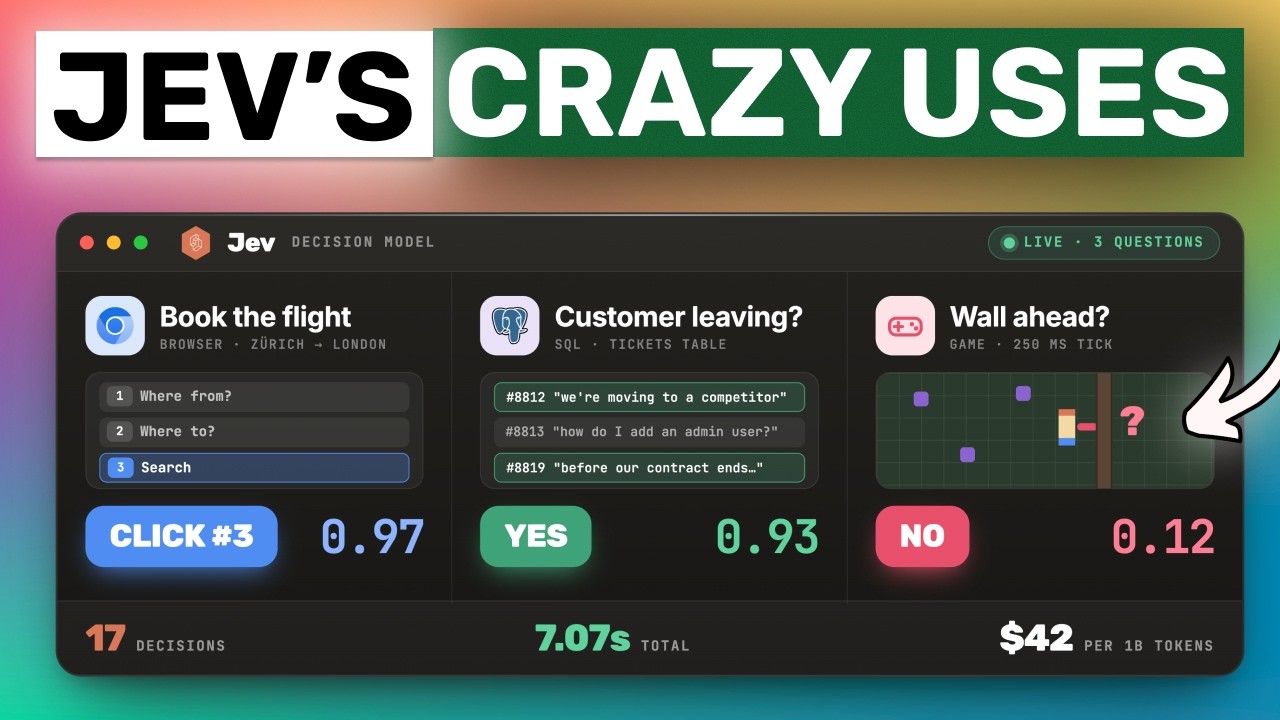
This video compares open implementations of Jev-style universal classification, including logit readouts, hidden-state projection, contrastively trained LoRA adapters, entailment, diffusion, and ModernBERT. It shows how their speed, cost, confidence, modality support, and generalization limits determine where each approach fits.
Sam Witteveen22 minTranscript found
Quick learning frame
Read this before watching.
Creative automation accelerates production while keeping human taste in brief, source selection, generation, editing, and critique.
New playlist item from Sam Witteveen; queued for transcript-backed review, topic mapping, and a practical learning artifact.
Skill you build: The ability to choose and evaluate an open universal-classification approach by matching its architecture, training needs, and accuracy-speed tradeoffs to a concrete decision task.
Watch for the shift from claim to mechanism. The learning value is the point where the transcript reveals a repeatable action, tool boundary, context move, review habit, or artifact.
Concept diagram
Where this video fits.
01Brief
02Source material
03Generation
04Selection
05Edit
06Taste review
07Reusable recipe
Deep lesson
Turn this video into working knowledge.
4,351 cleaned transcript words reviewed across 1,202 timed caption segments.
Thesis
Open Jev Models Are Here!! teaches a practical creative automation move: This video compares open implementations of Jev-style universal classification, including logit readouts, hidden-state projection, contrastively trained LoRA adapters, entailment, diffusion, and ModernBERT. It shows how their speed, cost, confidence, modality support, and generalization limits determine where each approach fits.
The goal is not to remember the video. The goal is to extract the operating principle, tie it to timestamped evidence, test how far the claim transfers, and make something reusable.
0:42
Classify Without Retraining
“at this, there were like a couple of these things. This morning, going through it, there's well over 20, maybe even 30 different projects out there of people trying to replicate this model. And some of them are...”
Jev's key value is not classification itself but using enough world knowledge to handle new labels and yes-or-no decisions without fine-tuning a separate model for every use case. That makes it possible to offload simple choices from slower reasoning LLMs. Rewrite one recurring reasoning prompt as a fixed choice or yes-no classification and list the evidence the classifier must use.
12:56
Architectures Trade Differently
“majority of classifications that I made in it seem to have a very high confidence. It was confident of its choices, not just a model hedging in there. Okay, so the other three that I've put in here,...”
The open projects reach Jev-like outputs through different mechanisms: reading option-token logits, projecting hidden states, testing entailment over text or images, or reading slot probabilities from a diffusion model. Their practical differences include decisiveness, concurrency, model size, multimodal support, and accuracy on unfamiliar cases. Make a comparison grid for Sem If, Decider, OpenJeb, and Diffusion Gemma covering mechanism, model size, modality, and reported limitation.
15:24
Cascade Hard Decisions
“was that it had kind of been under trained compared to say the Gemma 4 31B or the Quen models or things around that size. But speed wise, this thing's insane. So, you can see this is how...”
Open classifiers are close on easy and standard tasks but still struggle with multi-hop reasoning and date arithmetic. A useful deployment pattern is to let the fast model handle most inputs and escalate low-confidence cases to a reasoning model at low or medium effort. Design a two-stage decision flow with a confidence threshold, a fast classifier first, and explicit examples that must escalate to a reasoning model.
01
Brief
Start with this video's job: This video compares open implementations of Jev-style universal classification, including logit readouts, hidden-state projection, contrastively trained LoRA adapters, entailment, diffusion, and ModernBERT. It shows how their speed, cost, confidence, modality support, and generalization limits determine where each approach fits. Treat "Brief" as the outcome you are trying to make visible, not a topic label. Anchor it to 0:42, where the video says: “at this, there were like a couple of these things. This morning, going through it, there's well over 20, maybe even 30 different projects out there of people trying to replicate this model. And some of them are...”
02
Source material
Use "Source material" to locate the part of the creative automation mechanism the video is demonstrating. Ask what changes in your real setup if this claim is true. Anchor it to 12:56, where the video says: “majority of classifications that I made in it seem to have a very high confidence. It was confident of its choices, not just a model hedging in there. Okay, so the other three that I've put in here,...”
03
Generation
Turn "Generation" into the reusable artifact for this lesson: A creative production board with source inputs, prompt recipe, selection criteria, edit pass, and taste-review checkpoints. This is where watching becomes something you can inspect and reuse.
04
Selection
Use "Selection" as the application surface. Decide whether the idea touches a browser flow, a local file, a model choice, a source document, a UI, or a review step.
05
Edit
Use "Edit" to prove the lesson. The evidence should connect back to the video title, transcript anchors, and a concrete output, not a generic best-practice claim.
06
Taste review
Use "Taste review" to carry the idea forward: save the prompt, checklist, diagram, or operating rule that would make the next agent run better.
07
Reusable recipe
Connect "Reusable recipe" to Open Jev Models Are Here!! by naming the claim, the evidence, and the artifact it should produce.
Example
Source-backed artifact packet
Convert the video into a scoped artifact request that includes the transcript claim, mechanism, acceptance criteria, and proof. The output should be a creative production board with source inputs, prompt recipe, selection criteria, edit pass, and taste-review checkpoints..
Example
Creative automation proof brief
Separate what the speaker claims, what the demo actually proves, and what still needs outside verification before you adopt the creative automation pattern.
Example
Teach-back module
Transform the lesson into a definition, a Brief -> Source material -> Generation -> Selection -> Edit -> Taste review -> Reusable recipe diagram, one misconception, one practice exercise, and a check-for-understanding question.
Do not learn it wrong
Treating the title as the lesson without checking what the transcript actually says.
mistaking novelty for quality
no source/brief discipline
shipping generated media without taste review
Letting the lesson drift into generic content advice.
Letting the lesson drift into tool hype.
Letting the lesson drift into creative output without selection criteria.
Do not count this as learned until these are true.
01
State the transcript-backed claim in your own words: This video compares open implementations of Jev-style universal classification, including logit readouts, hidden-state projection, contrastively trained LoRA adapters, entailment, diffusion, and ModernBERT. It shows how their speed, cost, confidence, modality support, and generalization limits determine where each approach fits.
02
Explain the practical stakes without hype: New playlist item from Sam Witteveen; queued for transcript-backed review, topic mapping, and a practical learning artifact.
03
Map the idea onto the Brief -> Source material -> Generation -> Selection -> Edit -> Taste review -> Reusable recipe sequence and name the weakest link.
04
Produce the artifact and include the evidence that proves it: A creative production board with source inputs, prompt recipe, selection criteria, edit pass, and taste-review checkpoints.
Put it into practice
Give this grounded prompt to Codex or Claude after watching.
You are helping me turn one specific YouTube video into real, durable learning.

Source video:
- Title: Open Jev Models Are Here!!
- URL: https://www.youtube.com/watch?v=53wDOI_7x8I
- Topic: Creative Automation
- My current learning frame: Choose a narrow policy decision, express it as fixed output options, create one contrastive pair by changing only the decisive fact, and specify when a low-confidence result should escalate.
- Why this matters: New playlist item from Sam Witteveen; queued for transcript-backed review, topic mapping, and a practical learning artifact.

Transcript anchors from this exact video:
- 0:42 / Evidence 1: "at this, there were like a couple of these things. This morning, going through it, there's well over 20, maybe even 30 different projects out there of people trying to replicate this model. And some of them are..."
- 2:36 / Evidence 2: "would say that that entails. And you can actually sort of think about that those kinds of things could be trained for a more generalized sort of yes-no kind of thing, which is one of the tasks that..."
- 4:49 / Evidence 3: "system 2 model still wins for different hard tasks, but it's costing roughly six times as much as Jev, and is much, much slower here. Let's look at a few of these projects, see what differentiates them, and..."
- 6:43 / Evidence 4: "it really understands that, okay, it's required there. So, this is the typical kind of use that we would use Jeb for. And that actually brings us to Bespoke Nimble. It's the same sort of readout trick, but..."
- 12:56 / Evidence 5: "majority of classifications that I made in it seem to have a very high confidence. It was confident of its choices, not just a model hedging in there. Okay, so the other three that I've put in here,..."
- 15:24 / Evidence 6: "was that it had kind of been under trained compared to say the Gemma 4 31B or the Quen models or things around that size. But speed wise, this thing's insane. So, you can see this is how..."
- 21:09 / Evidence 7: "really nice model to try for some of these tasks and for doing your own sort of Laura's and stuff for this kind of thing. So, I'm going to probably have a play with that. If people are..."

Video-aware target:
- Prompt lane: Creative automation
- Mechanism to extract: Extract the creative production loop, especially where the human keeps taste, selection, and final judgment.
- Artifact to produce: A creative production board with source inputs, prompt recipe, selection criteria, edit pass, and taste-review checkpoints.
- Artifact must include: brief; source inputs; generation recipe; selection criteria; edit/review checkpoint

Your task:
1. Use the transcript anchors above as the primary source packet. If you add outside context, label it clearly as outside context and keep it secondary.
2. Create a source-check table with columns: timestamp, claim, transcript support, what the demo proves, confidence, and what still needs verification.
3. Extract the actual teachable mechanism from the video: Extract the creative production loop, especially where the human keeps taste, selection, and final judgment. Do not invent claims that are not supported by the title, lesson frame, or transcript anchors.
4. Build a reusable learning artifact: A creative production board with source inputs, prompt recipe, selection criteria, edit pass, and taste-review checkpoints.
5. Include:
   - a plain-English definition of the core idea
   - a diagram or structured model using this sequence: Brief -> Source material -> Generation -> Selection -> Edit -> Taste review -> Reusable recipe
   - answers to these source questions: What asset is being produced? | What inputs and tools drive it? | Where does human taste intervene?
   - 3 concrete examples that apply the video idea to real agentic work, such as Claude-generated video campaign; image-to-site workflow; voice or video editing loop
   - 2 failure modes the video helps prevent, chosen from the transcript evidence and these likely risks: mistaking novelty for quality; no source/brief discipline; shipping generated media without taste review
   - a checklist for the next real workflow, focused on: brief, inputs, generation, selection, critique
   - one practical exercise with a clear done signal: Build one reusable creative recipe and define what would make the result rejectable.
6. Add a "learning transfer" section: what changes in my workflow tomorrow if I actually learned this?
7. Add a "source check" section that cites which transcript anchor supports each major takeaway.

Quality bar:
- Make this specific to "Open Jev Models Are Here!!", not a generic Creative Automation essay.
- Anchor each creative step to transcript evidence about inputs, model/tool choices, iteration, editing, or critique.
- Prefer operational examples, failure modes, and reusable artifacts over broad definitions.
- Call out uncertainty instead of smoothing over weak evidence.
- Avoid these generic drifts: generic content advice; tool hype; creative output without selection criteria.
- If evidence is weak or missing, stop and say what transcript segment or timestamp needs review instead of guessing.
- Finish with a concise artifact I could paste into my learning app.
Misconceptions
What to stop believing.
Creative AI removes the need for taste.
It increases the need for taste because output volume explodes.
The best prompt is enough.
References, critique, iteration, and post-production matter just as much.
Practice studio
Learning only counts when you make something.
01
Transcript evidence map
Separate what the video actually says from what you already believe about the topic.
3 source-backed takeaways with timestamps, confidence, and a transfer note.02
One useful artifact
Apply the video to a real workflow and produce a creative production board with source inputs, prompt recipe, selection criteria, edit pass, and taste-review checkpoints..
A reusable artifact with a done signal and one verification step.03
Creative automation teach-back card
Explain the creative automation mechanism to someone who has not watched the video yet.
A 90-second explanation, one diagram, one example, and one misconception to avoid.
Recall check
Answer first, then reveal — without rewatching.
What makes Jev-style classification more universal than traditional task-specific classifiers?
How does the Diffusion Gemma implementation turn a diffusion model into a classifier?
What deployment pattern does the video recommend for cases that exceed open classifiers' capabilities?
Source shelf
Use the video as a doorway, then verify with primary sources.